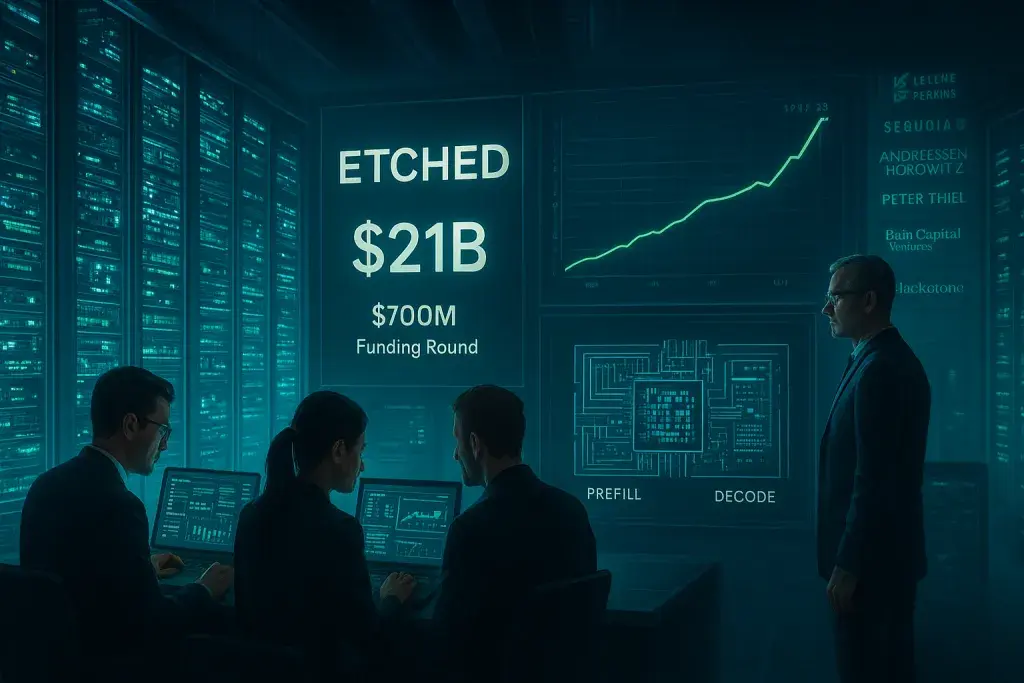
Etched announced Tuesday that it has raised $700 million at a $21 billion valuation, led by Jane Street after the quantitative trading firm tested and purchased the startup's AI hardware. The jump is steep by any measure: Etched was valued at $5 billion in December, then $10.3 billion in July following a $300 million Series C. A month later, investors have more than doubled that figure, adding roughly $11 billion in valuation on the strength of a single high-profile customer's hands-on trial.
This is not a cannabis story on its face, but the mechanics behind it echo something dispensary operators and technology vendors in regulated retail already understand well: infrastructure decisions get made by the people who actually run the workload, not by those who merely pitch it. Just as a multi-state operator evaluating point-of-sale software wants to see it handle real transaction volume, tax calculations, and inventory sync before committing store-wide, Jane Street didn't just review a deck. It installed a rack in its own datacenter and ran production workloads against it. That same logic applies down-market too; a dispensary comparing systems built for compliance-heavy environments, such as marijuana dispensaries point of sale virginia, needs proof that seed-to-sale reporting, age verification, and tax withholding actually function under live conditions, not just in a sales demo. marijuana dispensaries point of sale virginia
Why the Hardware Design Matters
Etched's pitch centers on splitting inference into two distinct problems and building separate hardware for each. The "prefill" stage, where a system parses a prompt and its context, is compute-intensive; the "decode" stage, where the system generates output, is memory-intensive. Etched built a low-voltage prefill chip that packs in more transistors without the heat penalties typical of high-end AI silicon, and a new interconnect it calls cluster-scale memory, letting many chips share a single low-latency memory pool. Co-founder Robert Wachen frames the result as higher throughput at lower cost - the kind of efficiency argument that resonates with any operator watching margins get squeezed by fixed costs.
The Rebrand From Single-Model Chips
Etched's name created a lasting misconception: that its chips were etched to run one specific frontier model and nothing else. That was the original plan. It isn't the current one. Etched's systems now run any frontier model, which matters for the same reason flexible retail software matters to dispensary owners - nobody wants to lock capital into infrastructure that only works for a single vendor relationship, especially in a market where the leading players change fast.
What the Investor List Signals
Kleiner Perkins, Sequoia, Andreessen Horowitz, Peter Thiel, Tiger Global, Bain Capital Ventures, and Blackstone are among the backers, alongside Jane Street. That's a roster built on conviction that inference - not model training - is where the next infrastructure spend concentrates. For any regulated industry watching compute costs climb, whether that's quant trading or, on a much smaller budget line, a dispensary's own cloud-based compliance software, the underlying tension is the same: the tools that verify, record, and process transactions are becoming as consequential as the products or trades sitting on top of them.