Four million cruise passengers move through Barcelona annually, and roughly 1.7 million of them never sleep in the city. They arrive at dawn, walk Las Ramblas, eat, and reboard by evening - generating foot traffic on public infrastructure while contributing far less per capita to the local economy than overnight visitors. That arithmetic is driving a widening conflict between municipal governments across Europe and a cruise industry that has grown nearly twentyfold in passenger volume since 1985.
The Economics Don't Add Up the Same Way for Everyone
The cruise sector's own figures for Barcelona are substantial: roughly 9,000 jobs supported, €562 million contributed to Catalonia's GDP, and an average daily spend of €230 per passenger. Those are the numbers the industry leads with. Here's the catch - independent researchers, including a study co-authored by academics from the University of Girona and the University of Exeter and published in Marine Pollution Bulletin, flag a consistent methodological gap. Cruise passengers on port calls spend less than those figures suggest, because the all-inclusive model means meals, entertainment, and most spending already happen onboard before the ship ever docks.
A University of Bergen study reached a similar conclusion regarding Norwegian ports, finding that actual per-passenger local expenditure fell well short of what official figures claimed. The sector's counterargument is that official data includes hotel costs - costs that transit passengers simply don't incur - which inflates the apparent gap. Fair enough, as far as it goes. But it doesn't resolve the underlying tension: cities absorb the congestion, public-space wear, and service demand from port calls regardless of whether those passengers spend at local businesses or eat lunch on the ship.
Municipal Responses Are Fragmentary, and That's a Problem
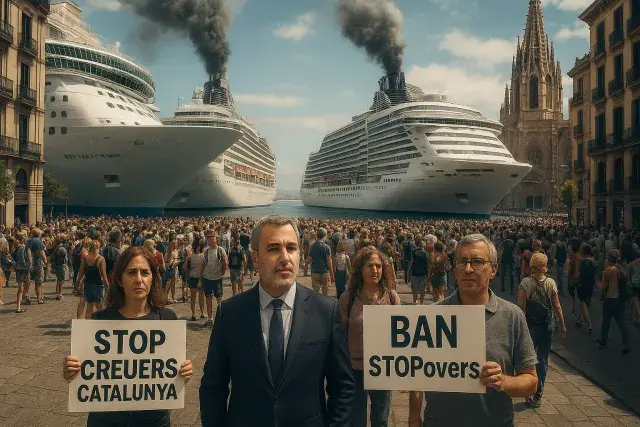
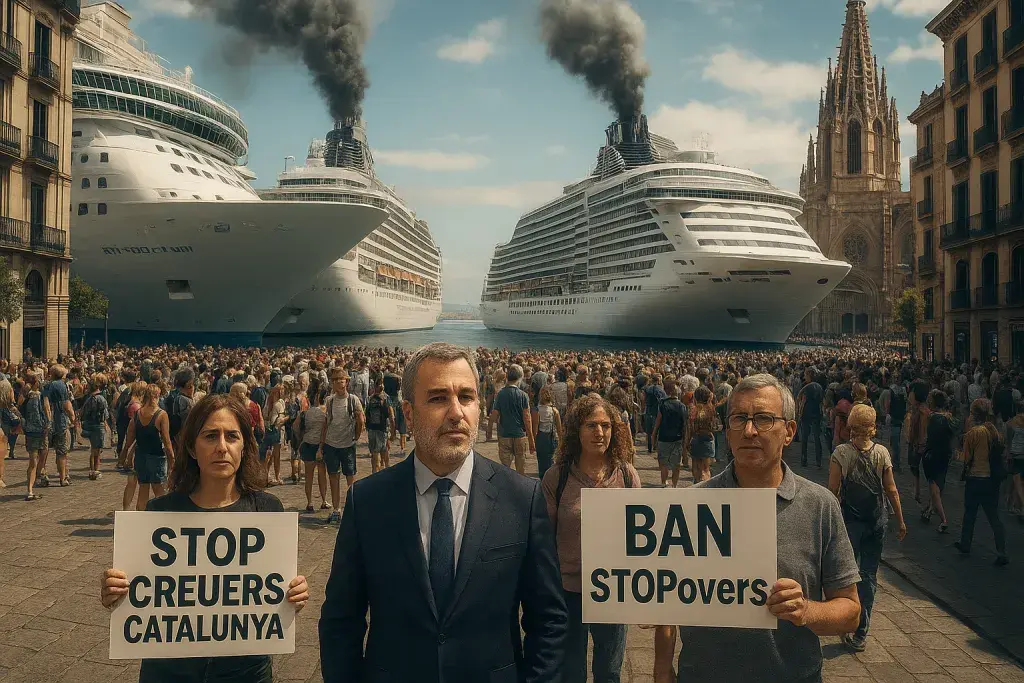
Barcelona's approach has been incremental: reducing cruise terminals from seven to five, proposing a doubled tourist tax for transit passengers, and now floating a ban on pure stopovers - allowing only embarkation and disembarkation calls, where passengers spend more time in the city. Mayor Jaume Collboni's position is that transit tourism creates intensive use of public space and services without proportionate economic return. Activists from Stop Creuers Catalunya argue these measures amount to cosmetic adjustment, not structural limits on capacity.
They're not alone in pushing back. A pan-European network now links advocacy groups from Venice, Marseille, Valencia, Palma, and A Coruña. Venice banned large vessels from the historic center. Palma and Amsterdam imposed daily caps. Cannes, Nice, Dubrovnik, and Santorini have each enacted their own restrictions. The patchwork nature of these responses matters - cruise itineraries are designed around multiple ports, and a restriction in one city simply shifts passenger volumes to the next stop.
In the United States, Key West voters approved a ballot measure in 2020 limiting daily disembarkations to 1,500 passengers. Florida's governor subsequently signed legislation stripping municipalities of authority over maritime traffic, effectively nullifying the vote. That episode is a clean illustration of the jurisdictional problem: port policy sits at the intersection of local planning authority, national maritime regulation, and the economic interests of a highly mobile, internationally incorporated industry. Cities rarely hold all the levers they need to act unilaterally.
Environmental Compliance Is Becoming a Harder Conversation
The pollution dimension is where the industry faces its most durable exposure. A Transport & Environment analysis using 2023 data found that cruise ships operating in European waters can burn fuel with sulfur content between 100 and 500 times higher than European road vehicle standards, depending on the route and whether cleaner fuels are used in port. Ships navigating in European Emission Control Areas are subject to stricter limits, but enforcement and fuel-switching compliance at berth remain inconsistent. The same analysis estimated that cruise ships in European waters emitted more than eight million tonnes of CO₂ in 2022 - roughly equivalent to 50,000 transatlantic flights.
Barcelona ranked as the European port where cruise ships logged the most cumulative hours at berth in 2022, which directly correlates with the highest port-based emissions from the sector on the continent. Shore power infrastructure - which allows ships to plug into grid electricity rather than run auxiliary diesel engines while docked - exists at some terminals but adoption across the fleet is uneven. This is a compliance and infrastructure investment story as much as an environmental one, and it's moving toward regulatory teeth at the EU level.
Industry Growth Hasn't Slowed, But the Tolerance Gap Is Widening
None of the current friction has dented bookings. According to Bob Levinstein, chief executive of Cruise Compete, a platform that aggregates pricing from cruise lines, cancellations have actually declined year-over-year while reservations have increased - even following the hantavirus outbreak on a Dutch vessel in the South Atlantic and a norovirus incident that resulted in approximately 1,700 passengers being confined in Bordeaux. Christos Lynteris, a professor of medical anthropology at the University of St Andrews, has noted that cruise ships are structurally prone to gastrointestinal and respiratory outbreaks, but has also pointed out that no pandemic or major land-based epidemic has originated from a cruise ship. The industry's health-safety record is complicated, but it hasn't broken consumer demand.
What is shifting is municipal tolerance. Royal Caribbean's Legend of the Seas, due to call at Barcelona, carries up to 7,600 passengers and 2,000 crew. The MSC World Europa, a regular on the Barcelona schedule, holds up to 6,700 passengers. On a single Saturday in July this year, Barcelona expects up to 26,000 cruise passengers in the city simultaneously. The scale is no longer abstract.
For port cities, the real policy question isn't whether to accept cruise tourism - the economic and connectivity arguments are real, and Barcelona's transatlantic air links developed in part because American cruise lines chose the city as a Mediterranean home port - but how to price and structure access so that public costs are genuinely offset. Tourist taxes are the obvious mechanism, and the industry itself projects that the recent increase in Barcelona could generate over €18 million in the current year, rising toward €26 million next year. Whether those figures match actual municipal costs from port-day congestion is a separate, and so far unresolved, calculation.