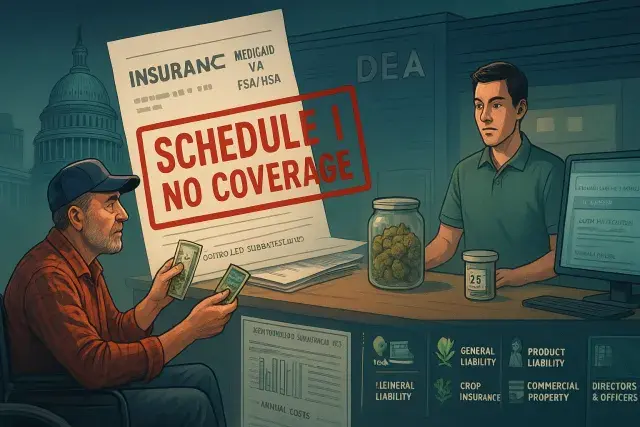
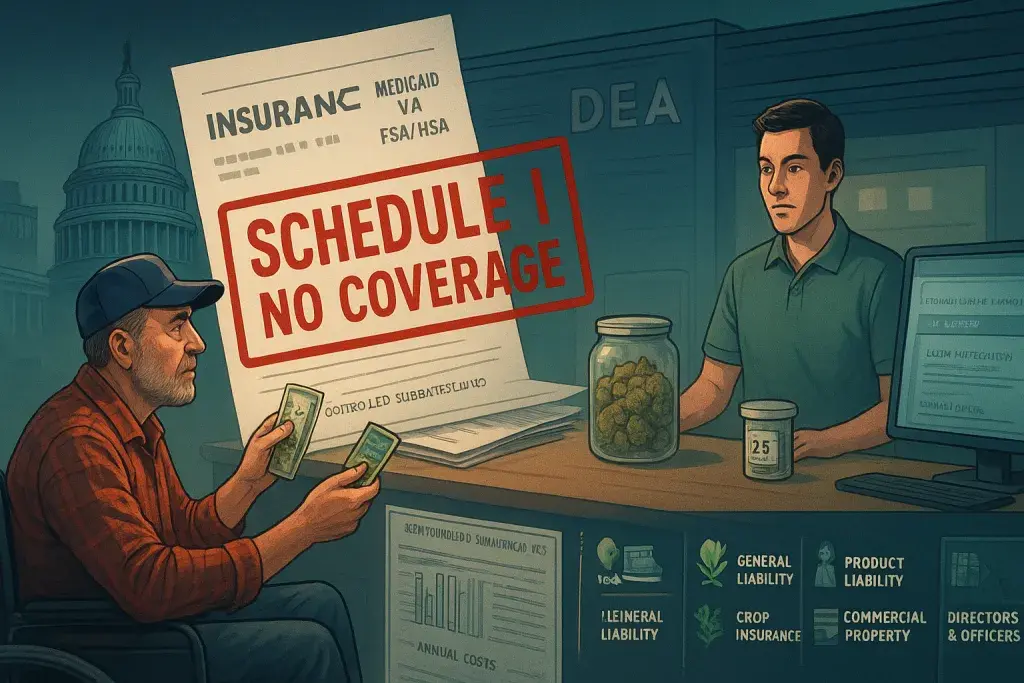
Medical cannabis is legal in most US states, yet patients purchasing it pay entirely out of pocket - no insurer reimburses them, no federal program covers it, and no FSA or HSA account can legally absorb the expense. The reason is not a gap in insurance product design. It is federal law. Cannabis remains a Schedule I controlled substance under the Controlled Substances Act, which defines it as having no accepted medical use, and that classification is the mechanism that locks every conventional coverage pathway shut.
The practical consequences fall hardest on high-frequency users and patients managing serious conditions, where annual cannabis costs can run into thousands of dollars with no reimbursement route available. Dispensary operators feel this indirectly - patients managing tight budgets make different purchasing decisions than those whose costs are offset by any form of benefit. That connection between policy and budroom behavior is one reason operators increasingly track the composition of their medical customer base carefully, and why tools like dispensary software in Nevada have expanded to support patient verification, medical card tracking, and tiered pricing workflows that help operators manage compliance around medical programs efficiently.
What makes this situation structurally distinct from most insurance coverage gaps is that the barrier is not actuarial - it is categorical. Private insurers operating under the Affordable Care Act, along with Medicare and Medicaid, cannot cover cannabis because federal law provides no framework for reimbursement of a Schedule I substance. The Department of Veterans Affairs operates under the same federal restrictions, meaning veterans cannot receive cannabis through VA-funded care even in states where both medical and adult-use programs are fully operational. No amount of clinical evidence accumulated at the state level changes that calculus while the federal classification holds.
What "Cannabis Insurance" Actually Covers - and Who It Serves
The term "cannabis insurance" does refer to real, active products. They just aren't designed for patients. The legal cannabis industry has built a dedicated commercial insurance market to address risks that standard carriers routinely exclude because of federal conflict. Dispensaries, cultivators, processors, and testing laboratories carry exposures that require purpose-built coverage.
- General liability insurance covers third-party claims for bodily injury or property damage
- Product liability addresses claims arising from cannabis products causing consumer harm
- Crop insurance covers losses from natural events, contamination, or equipment failure
- Commercial property coverage, often unavailable through standard carriers, is written by specialist insurers operating within state-legal frameworks
- Directors and officers liability has grown in demand as cannabis companies have scaled and brought on institutional investors
For operators, the practical question is not whether cannabis business insurance exists - it does - but whether the carrier writing the policy has genuine experience in the space. A carrier treating cannabis as a novel category will handle claims differently than one that has written policies across multiple state-legal markets. The National Cannabis Industry Association maintains resources to help operators evaluate their options. That distinction matters when a claim hits.
Patient-Side Alternatives: Limited, But Not Zero
On the patient side, formal insurance products remain scarce. A small but growing set of alternatives has developed around the cost problem, none of them a clean substitute for insurance coverage.
Some employers in legal states have begun including medical cannabis in health and wellness benefit packages, typically through third-party administrators rather than traditional insurers. These arrangements are narrow, vary significantly by employer and jurisdiction, and are not standardized in any meaningful way - but they represent a shift in how some workplaces are treating cannabis as a legitimate medical expense. Medical discount programs and cannabis membership clubs have also emerged in several markets. These are not insurance products in the regulatory sense; they provide members with reduced-cost access at participating dispensaries in exchange for a membership fee. Whether any given program delivers meaningful savings depends entirely on whether the dispensaries that participate carry the products a patient actually uses and whether the math on membership cost versus discount actually works out. Not all programs clear that bar.
FSAs and HSAs present a harder wall. Cannabis does not qualify as an eligible medical expense under IRS rules tied to federal scheduling, and patients who use these accounts for cannabis purchases risk penalties under current IRS guidance. Any change to that status requires either federal rescheduling or specific legislative action - neither of which has occurred. Patients should consult a tax professional before testing that line.
At the state level, several programs have built cost-reduction mechanisms directly into their medical frameworks. Reduced registration fees for low-income patients exist in a number of states, and many dispensaries operate patient assistance programs for verified medical cardholders - though these are rarely advertised at the point of sale. Asking directly, or through a patient advocacy organization, is often the most reliable way to surface what's available in a given market.
Rescheduling Would Open a Door, Not Solve the Problem
Federal rescheduling has moved from a speculative conversation to an active regulatory process. In May 2024, the Department of Justice and the Drug Enforcement Administration issued a notice of proposed rulemaking to move cannabis to Schedule III, and subsequent executive action directed the Attorney General to advance that process - though final action has not yet been taken as of this writing.
A Schedule III designation would remove the most fundamental legal barrier to coverage. It would not, however, automatically trigger health insurance reimbursement. Insurers would need to develop actuarial frameworks. Clinical evidence would need to accumulate through research channels that federal rescheduling would finally open. Prescription and pharmacy integration pathways would need to be established. Industry observers broadly expect a lag of several years between any rescheduling and meaningful insurance integration - and that estimate assumes the regulatory and legislative decisions that remain unresolved move in a consistent direction.
For dispensary operators, the near-term implication is straightforward: the out-of-pocket cost structure for medical patients is not going away on any timeline that affects current business planning. Understanding what assistance programs exist in your state, communicating them to medical cardholders at the point of sale, and building patient retention strategies that account for cost sensitivity are operational decisions that matter now - not after a regulatory outcome that may still be years away.