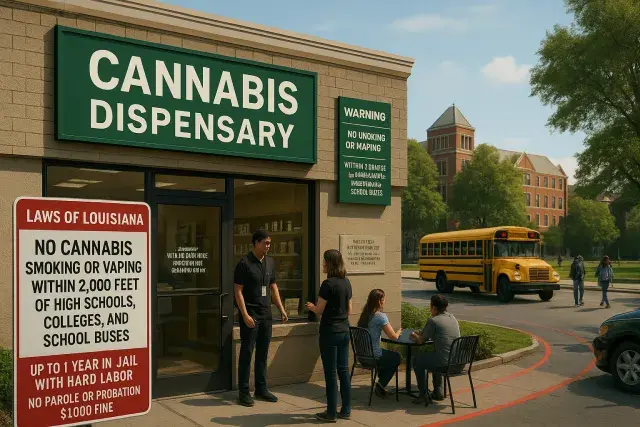
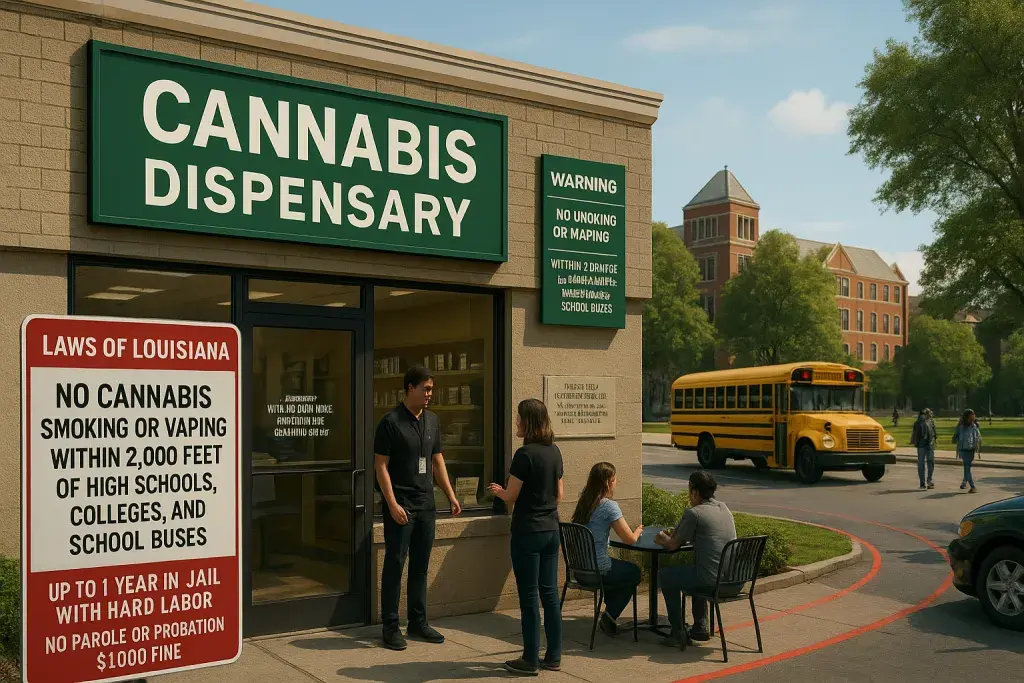
Louisiana Gov. Jeff Landry has signed legislation that makes smoking or vaping cannabis within 2,000 feet of a high school or college campus a criminal offense carrying enhanced jail terms - with sentences ineligible for parole, probation, or suspension. The law takes effect August 1 and applies to both school properties and school buses. For licensed cannabis operators in the state, it adds another layer of geographic and behavioral compliance to an already demanding regulatory environment.
The mechanics of the law are worth understanding precisely. Violations carry jail terms of up to one and a half times the longest otherwise authorized sentence, with no eligibility for parole or probation. Those convicted of solely cannabis offenses face up to one year in jail - with or without hard labor - and a $1,000 fine. Landry framed the measure in explicitly public-order terms, citing concerns about campus environments and the smell of cannabis on college grounds. For dispensary operators managing customer behavior and public perception, the dynamic here isn't entirely unlike what licensed retailers in other states have faced; in markets like California, where state law imposes strict consumption restrictions in public spaces, tools like cannabis pos california systems have had to incorporate compliance prompts and customer-facing messaging that reflect local consumption rules - a reminder that retail technology increasingly has to track regulatory geography, not just inventory.
The 2,000-foot buffer is the number that should register with anyone operating a dispensary in Louisiana. That radius is not trivial in urban areas. Depending on a store's location relative to nearby campuses, a licensed retailer's immediate sidewalk footprint, parking lot, or adjacent outdoor space could fall within a zone where consumption by a customer - even a legal adult - triggers criminal exposure. Dispensaries that have built outdoor waiting areas, smoking accommodations, or consumption-adjacent spaces near their entrances need to audit their physical footprint against this new boundary with care.
What the Enhanced Penalties Actually Mean
The sentencing structure is deliberately punitive. Stacking penalties at one and a half times the base authorized term, then stripping out parole and probation eligibility, is a hard-line approach. Louisiana already operates under a legal framework where adult-use cannabis remains illegal at the state level - medical cannabis is the licensed market - so this law doesn't represent a rollback of adult-use rights that don't yet exist there. What it does represent is an escalation of enforcement posture around any cannabis consumption in proximity to educational institutions. The hard labor provision attached to the one-year sentence for cannabis-only offenses is a detail that will not be lost on defense attorneys or advocacy groups, and it signals how the current administration intends to treat the issue politically.
For multi-state operators with Louisiana exposure, this is a compliance signal, not just a news item. Any licensed dispensary in the state should be reviewing its customer communication materials, posted signage, and staff training scripts to ensure no ambiguity exists about where consumption is and is not permitted. That responsibility doesn't evaporate at the point of sale.
The Broader Regulatory Pattern
Louisiana isn't operating in isolation. Across multiple states, regulators have applied school proximity rules - sometimes called buffer zone requirements - to dispensary siting and licensing, typically prohibiting licensed retail locations from operating within a set distance of schools. What's different here is that this law targets consumption behavior by individuals, not the location of licensed businesses. That's a meaningful distinction. It shifts enforcement from a licensing and real estate compliance question to a criminal law question - one that affects anyone in public space, not just businesses with a license on the wall.
The thing is, licensed operators have good reason to pay close attention even if their stores are nowhere near a campus. In states where the licensed market is still building public legitimacy - and Louisiana's medical cannabis program is still relatively young - high-profile criminal enforcement tied to cannabis consumption can affect consumer sentiment, influence future ballot or legislative efforts, and shape how regulators approach the program overall. Reputational spillover is real. An arrest in a dispensary parking lot that falls within a 2,000-foot zone doesn't stay local for long.
Operational Steps Operators Should Consider Now
Before August 1, Louisiana dispensary operators and compliance officers would do well to take a few concrete steps:
- Map every licensed retail location against the 2,000-foot radius from the nearest high school and college campus - including community colleges and satellite campuses
- Review exterior signage to ensure no-consumption messaging is visible and explicit
- Update staff training to include verbal reminders to customers about consumption laws, particularly in markets near universities
- Consult with legal counsel on whether any on-site features - designated waiting areas, outdoor seating - create liability exposure under the new statute
- Document compliance efforts; in a regulatory environment this focused on enforcement optics, a paper trail matters
To put it plainly: the law doesn't require dispensaries to do anything differently at the point of sale. But the licensed cannabis industry has long understood that its operating environment extends well beyond the four walls of the store. Louisiana just made that perimeter a lot more consequential.