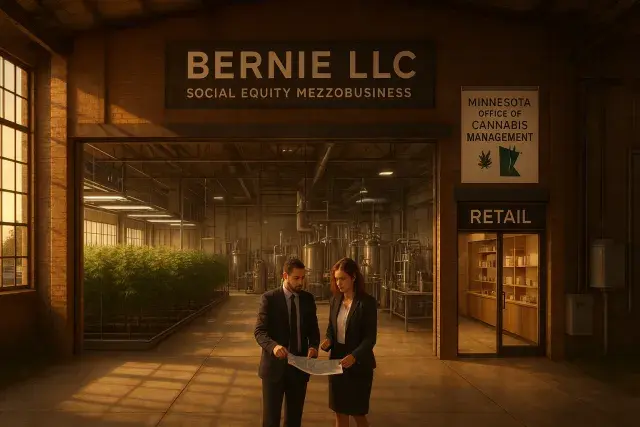
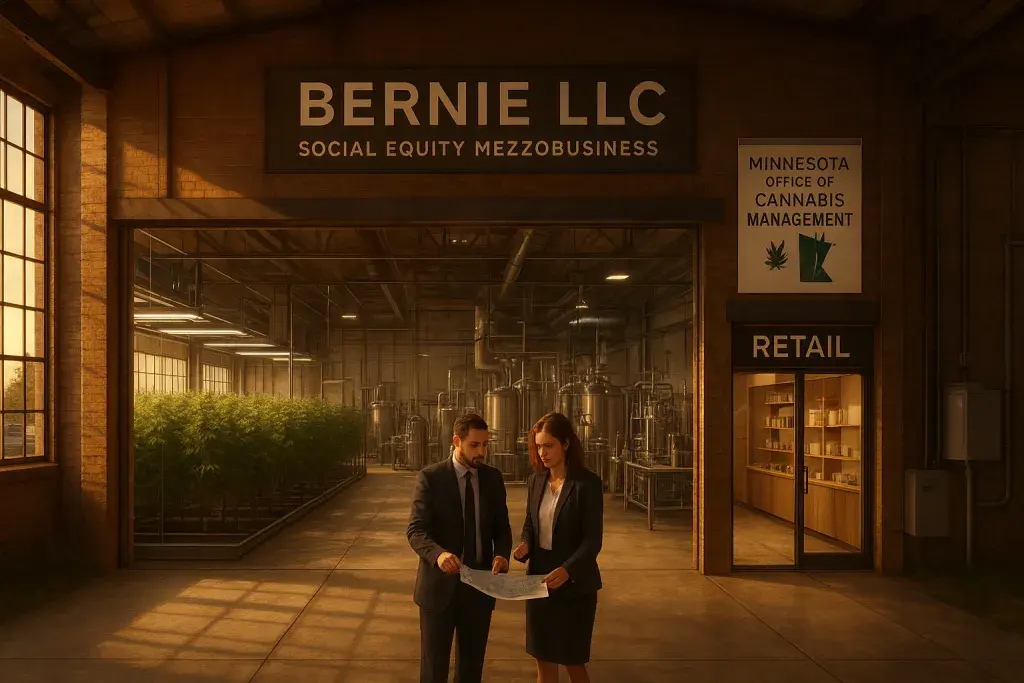
Bernie LLC has cleared a significant hurdle in Minnesota's emerging cannabis market, receiving city approval to establish a combined manufacturing, cultivation, and retail operation inside a former Second Harvest Northland warehouse in LaPrairie. The company holds preliminary social equity mezzobusiness license approval from the state Office of Cannabis Management and expects to open as early as this summer - though, as general manager Adam Nelson put it, the timeline carries real uncertainty.
Vertical integration at this scale - cultivation, extraction, and retail under one roof - represents exactly the kind of capital-intensive, compliance-dense model that state regulators and social equity frameworks are designed to support but rarely make simple. Operators pursuing this structure in any regulated market face layered licensing requirements, facility build-out timelines, and seed-to-sale tracking obligations that don't always move at the same pace. For context, dispensary operators in adjacent markets have found that investing early in purpose-built compliance infrastructure - the kind of operational thinking behind tools like cannabis POS for Illinois dispensaries - tends to reduce friction once the retail floor opens. Minnesota's framework is newer still, and Bernie LLC's experience reflects how that added regulatory youth compounds the complexity.
Nelson was direct about the variables involved. "We're working with a relatively new regulatory authority and a nascent industry, so it's just complicated," he said, declining to commit to a specific opening date. That kind of candor matters - not just as expectation management, but as a signal of operational maturity. Premature launch dates in cannabis retail are a well-worn trap; supply chain readiness, certificate-of-analysis requirements on initial product batches, and final licensure sequencing all have the potential to push timelines. The facility itself, Nelson says, is the final step toward full licensure from the Office of Cannabis Management.
A Facility Built Around Extracts, With Room to Scale
The operation will occupy roughly 24,000 square feet inside the former warehouse, with cultivation capped at 15,000 square feet. The company's product focus leans toward cannabis extracts and concentrates - a category that demands more sophisticated processing equipment, stricter solvent handling protocols if applicable, and tighter lab testing documentation than flower alone. Concentrates also carry distinct packaging and labeling compliance requirements under most state frameworks, and Minnesota's OCM will be watching early licensees closely as it builds its enforcement posture.
Bernie LLC plans to launch with 10 to 15 full-time positions, scaling to 30 to 40 at full buildout. Nicolette Furlong, Nelson's partner, is the primary owner and CEO. A purchase agreement for the property is in place; Second Harvest Northland continues to operate a food shelf out of the building after ending warehouse operations, and the organization's president says further details will be shared once the transition is finalized.
Odor, Zoning, and the Neighbor Problem
The city's approval came with odor control conditions attached - a direct response to concerns raised by Thomas Newman, who owns Two Rivers RV and Campground on adjacent property and has housing development plans nearby. Newman's objection is a recurring pattern in cannabis facility permitting across the country: cultivation operations, particularly those growing at scale indoors, produce terpene-rich air that requires active mitigation systems to contain. Carbon filtration, negative pressure design, and HVAC engineering are standard tools, but they require ongoing maintenance and operational discipline to remain effective.
Nelson says a scent mitigation plan is in place. Newman remains unconvinced - and his skepticism about enforcement is worth taking seriously, not as a reason to block the project, but as a practical reminder that permit conditions are only as effective as the municipality's capacity and willingness to enforce them. Cannabis operators who treat odor control as a one-time installation rather than an ongoing operational obligation tend to generate exactly the kind of neighbor complaints that invite regulatory attention. The city added the conditions; whether it has the inspection infrastructure to back them up is a separate question.
What the Social Equity License Designation Actually Means Here
Bernie LLC's preliminary approval comes through Minnesota's social equity mezzobusiness license pathway - a licensing tier the OCM designed to lower barriers for applicants from communities disproportionately affected by cannabis prohibition enforcement. The mezzobusiness classification generally sits between a microbusiness and a larger commercial license, allowing more operational scope than the smallest tier while still carrying defined caps on canopy and output. For the company, the designation isn't just a compliance category; it affects processing timelines, fee structures, and potentially access to any state-level technical assistance programs tied to equity licensing. It also means the license is subject to scrutiny that accompanies priority-track programs - regulators and advocates alike will be watching whether early equity licensees succeed or face structural barriers that the framework failed to anticipate. Bernie LLC, if it opens on schedule, will be among the early data points Minnesota's OCM uses to calibrate how well the program actually works in practice.