
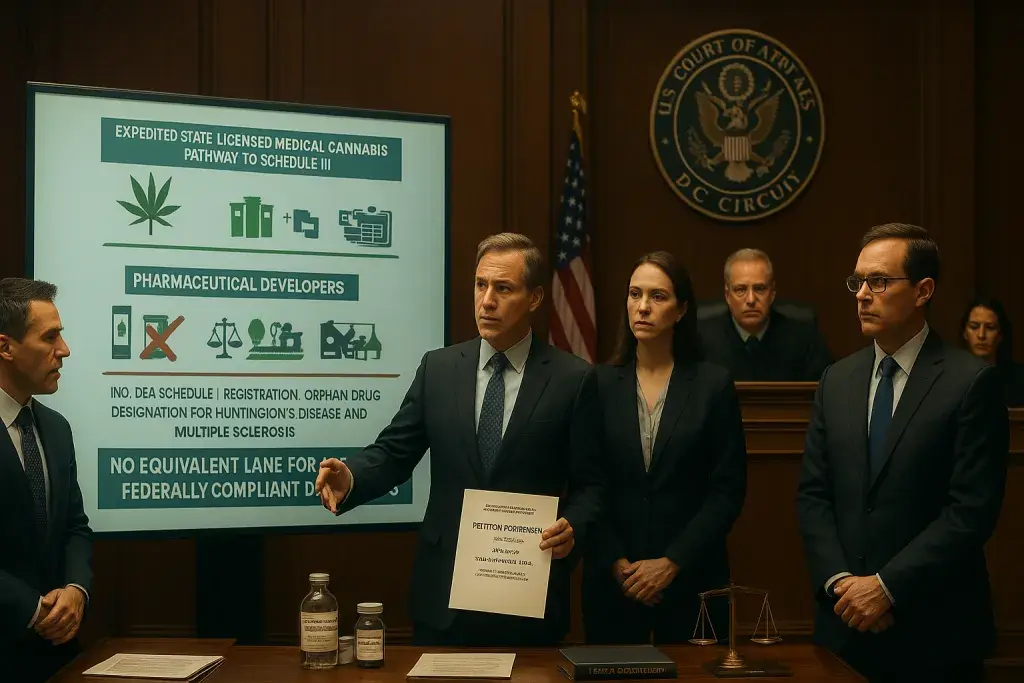
A company that spent years building a federally compliant cannabinoid drug development program is now suing the DEA over the agency's marijuana rescheduling order - and its core argument is that following the rules put it at a competitive disadvantage. MMJ International Holdings, along with subsidiaries MMJ BioPharma Cultivation and MMJ BioPharma Labs, joined a Petition for Review filed in the U.S. Court of Appeals for the D.C. Circuit challenging DEA's April 2026 Final Order, which moved certain marijuana products to Schedule III and created an expedited federal registration pathway for state-licensed medical cannabis operators.
What the Rescheduling Order Actually Did
The DEA's Final Order didn't simply shift marijuana down the scheduling ladder. It established a two-track structure. FDA-approved marijuana products and state-licensed medical marijuana products were reclassified to Schedule III - a meaningful change that reduces research barriers and certain manufacturing constraints. But the order also created an accelerated registration pathway specifically for existing state medical cannabis licensees, allowing them to move toward federal compliance faster than companies that never held a state license in the first place.
That's where the friction begins. For operators in state-licensed markets, the order reads as regulatory relief - and potentially a bridge toward legitimacy under federal law. For a company like MMJ, which deliberately avoided the state licensing route and instead pursued FDA Investigational New Drug applications, DEA Schedule I laboratory registration, pharmaceutical-grade manufacturing, and Orphan Drug Designation, the same order looks like a penalty for compliance.
The petition frames this plainly: state operators who spent years operating outside the federal Controlled Substances Act are now being offered an expedited federal pathway. Meanwhile, MMJ's cultivation registration application - filed through the standard federal process - remains unresolved.
The Regulatory Fairness Argument
MMJ's challenge rests on several legal grounds: statutory authority, procedural violations, treaty obligations, constitutional concerns, and what petitioners describe as a novel regulatory framework that Congress never authorized. The company also references prior DOJ acknowledgment of constitutional concerns related to DEA administrative law judge removal protections - a thread that has surfaced in broader administrative law disputes across federal agencies in recent years.
The competitive injury claim is the most operationally tangible piece. Since DEA issued the Final Order, state cannabis licensees have a defined route to federal registration. Federally compliant pharmaceutical developers do not have an equivalent lane. That asymmetry, MMJ argues, constitutes material harm - not a hypothetical grievance, but a concrete disadvantage in a market where access to federal registration will shape which businesses can operate under the emerging regulatory structure.
Here's the catch, and it's a real one: the federal government has spent decades insisting that the proper pathway for cannabis medicines runs through FDA drug development - INDs, clinical trials, botanical drug programs, the full pharmaceutical stack. MMJ followed that instruction. The rescheduling order, as structured, rewards a different pathway without resolving the status of companies that took the agency's stated requirements seriously.
Broader Implications for Federally Compliant Cannabis Developers
MMJ is not the only entity that pursued the pharmaceutical development route for cannabinoid medicines. The DEA has maintained a controlled list of registered Schedule I cannabis researchers and manufacturers for years, each of whom went through lengthy federal review processes, facility inspections, and compliance documentation. If the rescheduling order's expedited pathway is upheld, those developers face a structural question: does federal compliance convey any regulatory advantage, or does it simply mean a longer wait?
That question matters beyond MMJ specifically. The D.C. Circuit is the federal appellate court that handles most challenges to major agency rulemaking. A ruling that scrutinizes DEA's authority to structure the rescheduling order this way - or that finds procedural defects in how the Final Order was issued - could reshape the regulatory timeline for the entire Schedule III transition.
For cannabis industry stakeholders watching the rescheduling process, the case is worth tracking closely. State operators who anticipated streamlined federal registration may find that pathway subject to legal uncertainty. Companies in pharmaceutical cannabinoid development have a potential advocate making a procedural and competitive fairness argument at the appellate level. Investors and compliance professionals in both segments should treat the litigation as a live variable in any planning around federal licensing or interstate commerce scenarios.
The Patient Access Dimension
MMJ has been deliberate about framing the stakes in patient terms. The company's pharmaceutical development program includes cannabinoid-based therapies for Huntington's disease and Multiple Sclerosis - conditions with limited treatment options and no shortage of urgency. Orphan Drug Designation from FDA signals that the agency recognized an unmet medical need serious enough to extend development incentives.
Regulatory delay in this context isn't an abstraction. Every year that a cultivation registration application sits unresolved, clinical development timelines stretch. That's not a rhetorical point; it's a structural feature of how pharmaceutical drug development works. Without a resolved DEA cultivation registration, a company cannot move certain research activities forward under FDA oversight - which means patients waiting on those programs wait longer too.
Whether the courts ultimately agree with MMJ's legal theory or not, the case forces a question that federal regulators will have to answer somewhere: what is the federal pharmaceutical cannabinoid pathway actually worth, and does the government intend to honor the commitments implied by its own drug development infrastructure?