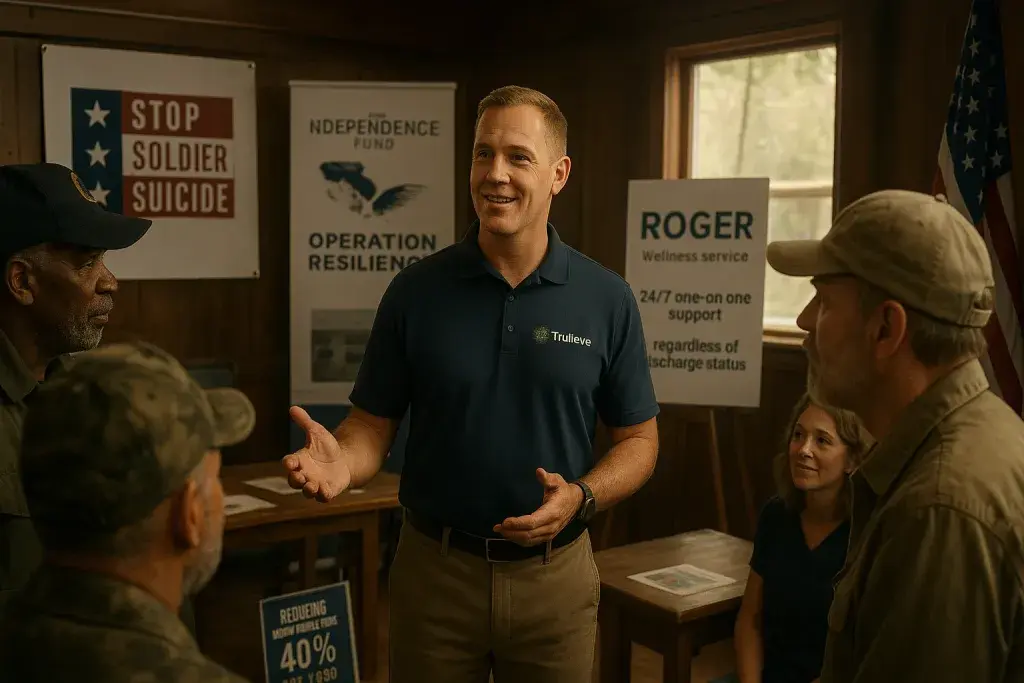
A cannabis multi-state operator is putting institutional weight behind veteran mental health outreach - and this time, the effort isn't coming from a marketing department. Trulieve's executive director of production, a 15-year Air Force veteran who served across Operation Iraqi Freedom, Operation Enduring Freedom, and the Global War on Terrorism, is leading the company's May partnerships with Stop Soldier Suicide and The Independence Fund's Operation Resilience program. The convergence of personal biography, corporate infrastructure, and evidence-driven nonprofit programming is worth examining closely - because it represents something the cannabis industry doesn't always get right.
Why Corporate Commitments to Veterans So Often Fall Flat
Cannabis companies have been vocal about veteran hiring and military community support since the earliest days of state-level medical programs. The pitch is consistent: veterans understand discipline, compliance culture, chain of command, and high-pressure operations - attributes that translate directly into dispensary management, cultivation facility oversight, and regulated logistics. That's not wrong. But the gap between stated commitment and sustained operational investment has been wide enough to notice.
What's different here is the mechanism. Trulieve's partnership with Stop Soldier Suicide isn't structured as a sponsorship banner at an industry event. Stop Soldier Suicide operates as the only national nonprofit focused exclusively on reducing military suicide rates, and its ROGER wellness service delivers around-the-clock, one-on-one intervention at no cost to veterans or service members - regardless of discharge status or branch. That last detail matters. Discharge status has historically been a gatekeeping factor for veterans seeking support through institutional channels, and it locks out exactly the population most at risk. A program that removes that barrier is doing something functionally different from a general awareness campaign.
The organization has set a public, measurable target: a 40% reduction in military suicide rates by 2030. Whether that figure proves achievable is a question the data will answer. What it signals, organizationally, is accountability - the kind that a compliance-trained industry should recognize immediately.
What the Red, White & Blue Tour Produced in Practice
The awareness event held at American Legion Post 13 in Tallahassee in connection with the Red, White & Blue Tour was built around direct access - local physicians, peer networks, and structured pathways into follow-up care. The results described are concrete: veterans who had withdrawn from help began requesting it; peer connections that had quietly dissolved were restored; every participant enrolled in follow-up care. That last point is operationally significant. Getting someone to show up is one problem. Getting them to stay engaged is another problem entirely.
The Independence Fund's Operation Resilience program is built around the premise that unit cohesion - the same bonds that sustain performance under pressure during active service - is a measurable protective factor against veteran suicide. Research across multiple disciplines supports the link between social connection and mental health outcomes in veteran populations; this isn't a philosophical position but a program design principle. Rebuilding those structures in a civilian context is slower and less automatic than the military environment that originally created them. Which is, to put it plainly, the whole point.
What This Means for Cannabis Operators Watching
For multi-state operators and licensed cannabis businesses evaluating their own workforce strategies, there's a practical layer to this worth parsing. Trulieve currently employs more than 175 veterans - a figure with direct implications for HR policy, benefits design, and workplace mental health infrastructure. Cannabis retail environments carry occupational stressors that the broader industry underreports: cash-handling risk, compliance pressure, shift-work volatility, and in some markets, the social weight of working in a still-stigmatized sector. Veteran employees often bring exceptional reliability and operational discipline, but they also bring lived experiences that require thoughtful support structures, not just hiring targets.
Operators who treat veteran hiring as a recruitment talking point without building the internal scaffolding - peer support access, mental health benefits that function across insurance coverage gaps, connections to programs like ROGER - are leaving real risk unaddressed. The cannabis industry is not unique in this failure, but it operates in a context where 280E tax treatment already compresses margins and benefits packages are one of the first places operators look for cost relief. That trade-off has human costs.
There is also something worth naming about the credibility question. The executive driving this initiative spent 15 years in uniform and now manages 1,400 citrus trees on a working farm - a life built around patient, steady tending of what grows slowly. That background shapes how the commitment reads from the outside. It is not the same as a vice president of community affairs issuing a statement during a designated awareness month. The industry has seen enough of those to know the difference.
A Standard Worth Holding Onto
Cannabis companies operate under intense scrutiny - regulators, investors, community stakeholders, and a public that remains genuinely divided about the industry's social role. Partnering authentically with organizations like Stop Soldier Suicide and Operation Resilience, with measurable program design and personal accountability behind the effort, is the kind of activity that builds durable standing - not just optics.
The veteran suicide rate is not an abstraction. The daily losses are not a statistic to deploy for brand positioning. What makes this effort worth attention is that the people leading it seem to know that.
If you or a veteran you know is in crisis, Stop Soldier Suicide's ROGER service is available at stopsoldiersuicide.org. The Veterans Crisis Line can be reached by calling 988 and pressing 1.