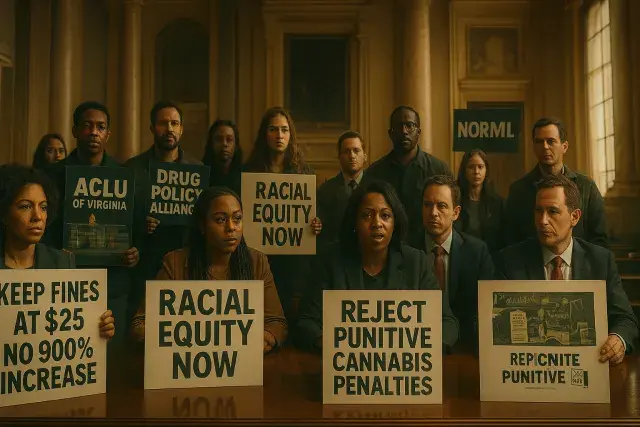
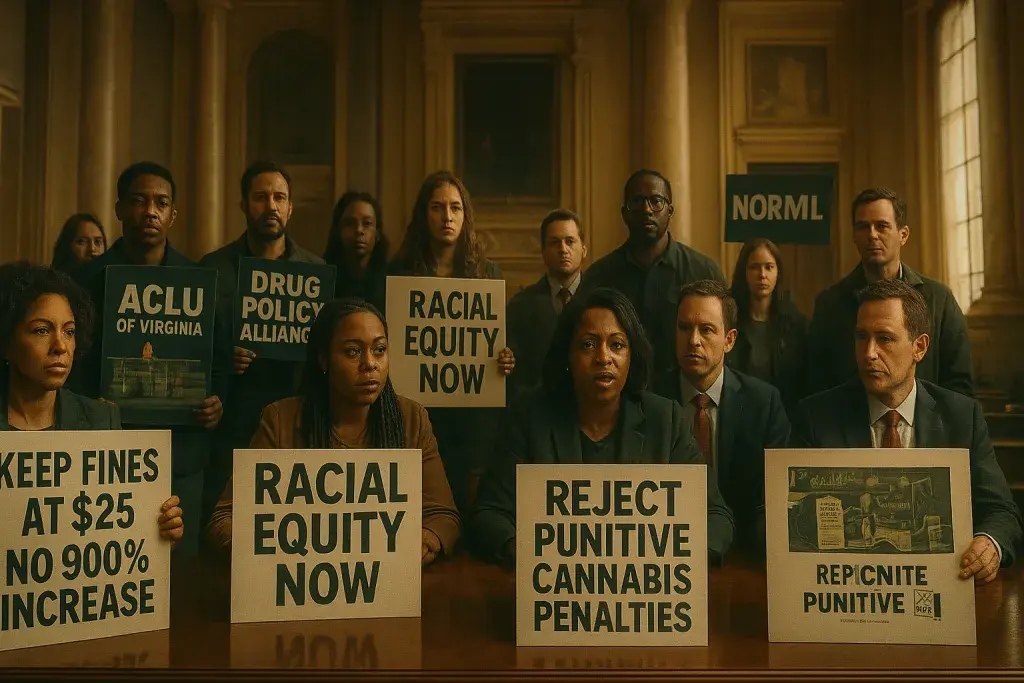
A broad coalition of marijuana reform and social justice organizations is pressing Virginia Gov. Abigail Spanberger and state legislators to strip a proposed tenfold increase in public cannabis consumption fines from the compromise budget legislation that would legalize adult-use marijuana sales in the commonwealth. The budget bill - which includes the cannabis provisions - is set for a Virginia Senate vote on Monday, with the House of Delegates expected to follow shortly after. At stake is whether Virginia's legalization framework opens with a public health and equity mandate or quietly reconstructs the low-level enforcement apparatus it was supposed to dismantle.
Under current Virginia law, consuming cannabis in public is a civil infraction carrying a $25 fine. The compromise negotiated between Spanberger and bill sponsors Sen. Lashrecse Aird and Del. Paul Krizek would raise that penalty to $250 - a 900 percent increase. The governor had originally sought to elevate the offense to a class 4 criminal misdemeanor, so the $250 civil fine represents a concession of sorts. But to groups including the ACLU of Virginia, the Drug Policy Alliance, NORML, the Marijuana Policy Project, and the Latino Cannabis Alliance, among others, "less harsh than a misdemeanor" is not the same as "acceptable." For operators and compliance professionals watching how legal frameworks take shape in other states, the pattern is familiar - regulators in early-stage markets (even those as technologically developed as states with mature dispensary pos alaska infrastructure) have learned that consumer-facing penalties shape purchase behavior, enforcement risk, and community trust in ways that affect licensed retail foot traffic over the long term.
The coalition's letter to Spanberger and legislators makes the argument plainly: higher fines for low-level possession and use are not enforced uniformly. They tend to fall hardest on Black and brown residents, on people with lower incomes, and - critically for advocates - on individuals for whom a civil fine can trigger downstream consequences in immigration status, housing eligibility, employment, and education access. The organizations are calling on state officials to hold the $25 civil fine, reject any proposals that raise fines or add criminal penalties for low-level use, and anchor all cannabis policy in racial equity and harm reduction data rather than punitive presumption.
What the Compromise Deal Actually Contains
The broader cannabis framework embedded in the budget legislation has significant operational implications for any business planning to enter the Virginia market. Legal adult-use sales would not begin until July 1, 2027 - a date Spanberger had pushed for, set six months later than the January 1, 2027 timeline lawmakers originally passed. The per-transaction purchase limit is set at 2 ounces of flower, or an equivalent amount of other cannabis products as determined by regulators, up from the current 1-ounce ceiling. Individual serving sizes would be capped at 10 milligrams THC, with no more than 100 milligrams per package - a consumer safety and packaging compliance specification that brands and manufacturers will need to build around from day one.
The excise tax structure starts at 6 percent, with an additional 5.3 percent retail sales and use tax and an optional local tax of up to 3.5 percent. On July 1, 2029, the state excise tax climbs to 8 percent. That escalating tax schedule matters for early-market financial modeling: operators projecting margin through the first two years of sales need to plan for a shift in their effective tax burden roughly 24 months in. Up to 350 licensed retail stores would be permitted statewide - more than the 200 Spanberger originally proposed, and matching the number lawmakers had approved. Local governments cannot opt out of allowing cannabis businesses to operate. Delivery services would be permitted.
The Fine Increase and Its Real Business Risk
Here's the catch for licensed operators: civil enforcement risk doesn't stay outside the dispensary. When public consumption penalties are steep enough to deter lawful consumers from even carrying product between their car and their home - or when enforcement patterns in certain zip codes make people risk-averse about purchasing at all - it compresses retail demand in exactly the communities that legal market access was supposed to serve. Social equity has never been purely a moral argument. It is also a market structure argument. Licensed cannabis retail grows fastest in markets where consumers trust that lawful purchase and use won't expose them to a paper trail of escalating civil debt.
The Drug Policy Alliance has separately launched a public action alert allowing Virginia residents to contact the governor and legislators directly. That kind of organized constituent pressure, arriving days before a scheduled vote, is not incidental. It signals that the coalition is treating this provision as a dealbreaker - not an asterisk. Notably, the fine increase would not take effect until July 1, 2026, which means the legislature would have the intervening session to revisit or rescind it. Advocates appear to be treating that window as both a risk and an opportunity.
What Comes Next
Virginia has had legal personal possession and home cultivation since 2021. Former Gov. Glenn Youngkin twice vetoed commercial sales legislation. Spanberger vetoed the most recent version in March after lawmakers declined to adopt her proposed amendments during a one-day reconvened session. The current compromise - embedded in must-pass budget legislation due by July 1 - is the most viable path remaining this cycle. Whether it passes with the $250 fine intact, passes with the fine removed, or stalls entirely will define not just Virginia's market launch but its equity baseline. For operators, investors, and compliance teams already scoping the state, the outcome of Monday's vote is worth watching closely. The fine provision may look like a minor detail. In practice, it isn't.