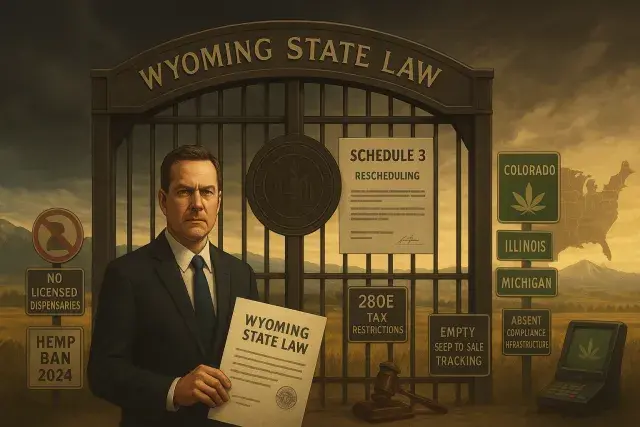
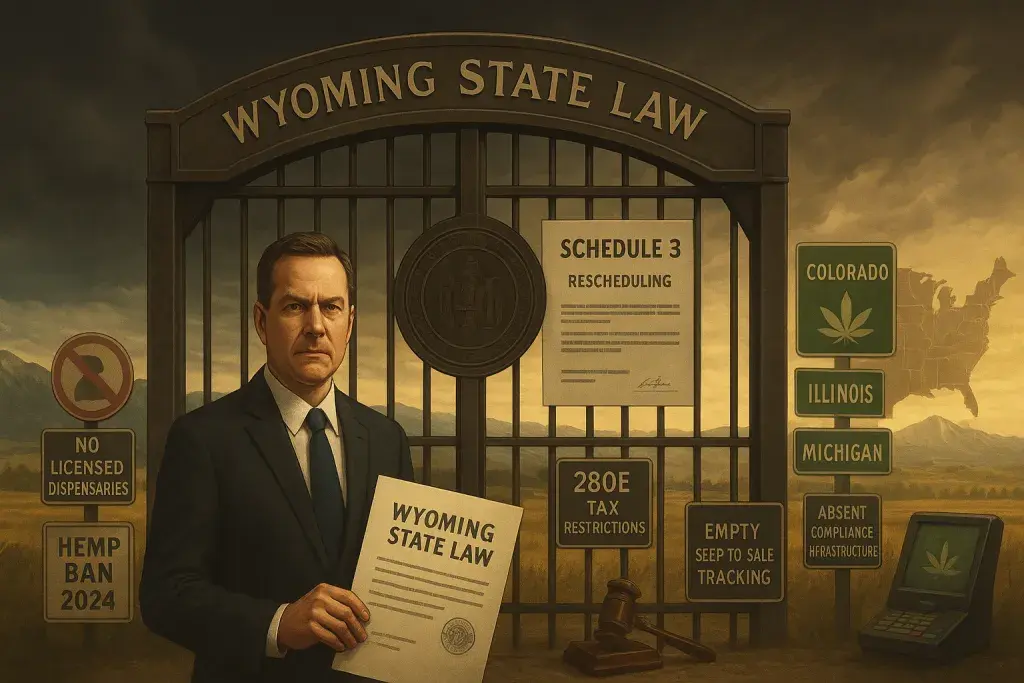
Wyoming's attorney general has formally objected to the federal reclassification of medical marijuana under the Controlled Substances Act, effectively blocking any rescheduling effect within state borders. Attorney General Keith Kautz filed the objection on May 28, invoking a provision in Wyoming law that allows the state to diverge from federal drug scheduling - and making clear that any change to Wyoming's cannabis laws must go through the state legislature, not federal administrative rulemaking. For the licensed cannabis industry watching DEA rescheduling proceedings closely, Wyoming's move is a concrete reminder that federal action doesn't automatically translate to state-level access or regulatory change.
The backdrop matters. The Trump administration's April rescheduling order moved "state-licensed" medical cannabis and FDA-approved marijuana products to Schedule 3 - a shift that operators in legal-state markets have been monitoring for its potential to unlock DEA registration, ease interstate commerce restrictions, and reduce the tax burden imposed by 280E, the federal provision that denies standard business deductions to cannabis companies. In states with mature regulated markets, compliance professionals and multi-state operators have been tracking every development. For context on how point-of-sale infrastructure and compliance technology are already layered into existing legal frameworks, resources like cannabis pos colorado reflect how operators in legal states are building operational infrastructure that rescheduling could eventually benefit. Wyoming, for the moment, is a different story entirely.
Kautz's objection rests on two narrow but firm grounds. First, only three FDA-approved marijuana products exist, and all three are already scheduled under existing law. Second, Wyoming has not legalized medical cannabis in any form. His statement was direct: the legislature, not an administrative process, should decide whether any marijuana product leaves Schedule 1 in Wyoming. That framing isn't just procedural - it's a policy signal. It tells the legislature, advocacy groups, and any business interests watching that the attorney general's office has no appetite for rescheduling through the back door.
A State With No Regulated Market and a History of Resistance
Wyoming is one of a shrinking number of U.S. states with no medical marijuana program and no adult-use legalization. That's not for lack of public interest - advocates have repeatedly attempted to move the needle. A 2023 effort to qualify a medical cannabis voter initiative for the 2024 ballot collapsed in part due to inconsistent guidance from state election officials. The legislature has not moved forward with its own cannabis bills. And in 2024, Wyoming banned Farm Bill-compliant hemp products, a ban that survived a court challenge in 2025. The pattern is consistent: state government in Wyoming has been more aggressive than most in closing off cannabis access, not expanding it.
What that means operationally is simple. There are no licensed dispensaries in Wyoming. There is no seed-to-sale tracking system, no compliance infrastructure, no wholesale market, no licensed cultivators or processors. Businesses that might otherwise be positioned to enter a new market - cannabis retailers, POS vendors, compliance software providers, real estate developers eyeing dispensary-ready commercial space - have no foothold and no regulatory framework to build against. Federal rescheduling, even if it ultimately takes full effect in most of the country, changes none of that in Wyoming as long as the legislature holds its current position.
Rescheduling's Uneven Geography - A Problem Operators Already Knew Was Coming
Wyoming's opt-out illustrates something the industry has been grappling with since rescheduling became a real possibility: federal action does not produce uniform state-level results. State drug laws vary in how tightly they track federal scheduling, and several states have procedural mechanisms - like Wyoming's attorney general objection process - that can pause or block automatic alignment. That's a compliance headache for any multi-state operator trying to build a consistent regulatory strategy across its portfolio.
It's also worth noting where the formal legal challenges are coming from. Indiana and Nebraska are the two states officially contesting rescheduling before a DEA administrative law judge in ongoing hearings. Nebraska's presence on that list is particularly pointed - the state recently legalized medical marijuana but has not yet launched a functioning dispensary market. Several other parties have filed suit in the D.C. Circuit Court of Appeals to block rescheduling altogether, a move the Trump Justice Department formally opposed on July 2. The DEA hearings are scheduled to conclude next week, but legal challenges in federal court could extend the uncertainty for months or longer.
What This Means for Businesses Watching the Rescheduling Process
For licensed operators in functioning markets, the Wyoming situation is informative rather than immediately disruptive. States with established regulatory frameworks - Colorado, California, Illinois, Michigan - are largely insulated from this particular wrinkle. But for businesses eyeing expansion, for payment processors hoping rescheduling softens banking constraints, and for B2B vendors selling compliance or point-of-sale technology, the Wyoming model is a reminder to read state law carefully before assuming federal rescheduling opens a door.
The more consequential near-term question is whether the DEA administrative process concludes cleanly, or whether federal court litigation delays Schedule 3's effective date across the board. If rescheduling gets tied up in appellate litigation, the downstream benefits - potential 280E relief, DEA registration for state-licensed operators, any relaxation of banking pressure - stay in limbo. Wyoming simply made its own position explicit. Other states haven't had to, yet.