
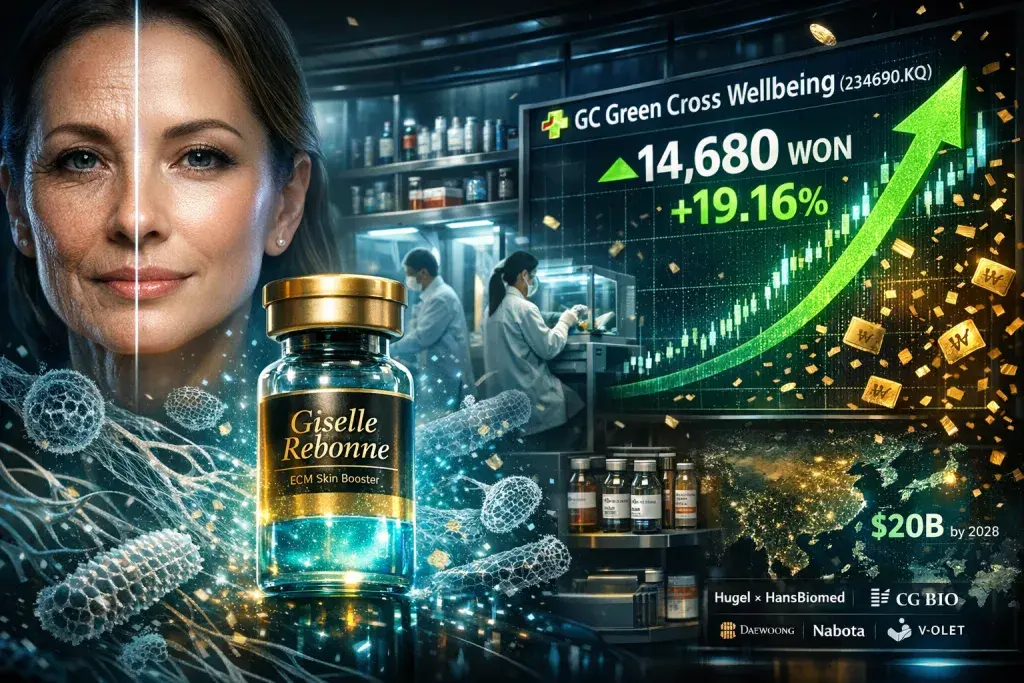
On July 25, shares of GC Green Cross Wellbeing (234690.KQ) rocketed 19.16% to close at 14,680 won, fueled by the announcement of its new human tissue-based extracellular matrix (ECM) skin booster, Giselle Rebonne. This surge underscores investor enthusiasm for cutting-edge regenerative aesthetics, signaling a shift toward more biologically advanced skincare solutions in South Korea's booming med-spa market.
Giselle Rebonne: Revolutionizing Skin Boosters with Human-Derived ECM
Giselle Rebonne stands out as a next-generation ECM skin booster derived from human acellular dermal matrix (hADM). Unlike traditional boosters that merely stimulate collagen indirectly, this product delivers the ECM structure directly, acting as a scaffold for true tissue remodeling and regeneration.
- Processed by MS Bio's proprietary decellularization to eliminate cells and immune triggers, ensuring high biocompatibility.
- Sourced and supplied via GC Green Cross Wellbeing's tissue bank at its Eumseong facility.
- Minimizes risks of rejection or inflammation, offering foundational skin restoration over superficial plumping.
Experts in regenerative dermatology view hADM-based therapies as a leap forward, mimicking the skin's native architecture to combat aging at its core—ideal for addressing fine lines, elasticity loss, and post-procedure recovery in an era of personalized aesthetics.
Strategic Portfolio Buildout Amid Competitive Landscape
The launch bolsters GC Green Cross Wellbeing's aesthetic lineup, now spanning placenta injections like Laennec, dermal fillers, skin boosters, and botulinum toxin Innovo. This mirrors rivals' moves: Hugel partners with Hans Biomed on Cellrderm, while CG Bio eyes bundled sales with Daewoong's Nabota and V-Olet.
- Stock jump of 2,360 won reflects market validation of vertical integration in biomaterials.
- Domestic focus leverages Korea's leadership in K-beauty exports and minimally invasive procedures.
By controlling raw materials and distribution, the company positions itself for scalable growth in a sector projected to exceed $20 billion globally by 2028, driven by demand for natural, long-lasting results.
Implications for Investors and Skincare Trends
The rally highlights broader trends in aesthetic medicine: a pivot from synthetic fillers to bioengineered regeneratives, fueled by consumer preference for "skin from within" amid rising wellness consciousness. In South Korea, where procedures per capita lead the world, ECM boosters could capture share from hyaluronic acid injectables, promising sustained revenue as clinics adopt multifunctional treatments.
Yet, regulatory scrutiny on tissue-derived products remains key; success hinges on proven safety data. For investors, this positions GC Green Cross Wellbeing as a frontrunner in Asia's anti-aging innovation wave, potentially sparking further M&A in biomaterials.