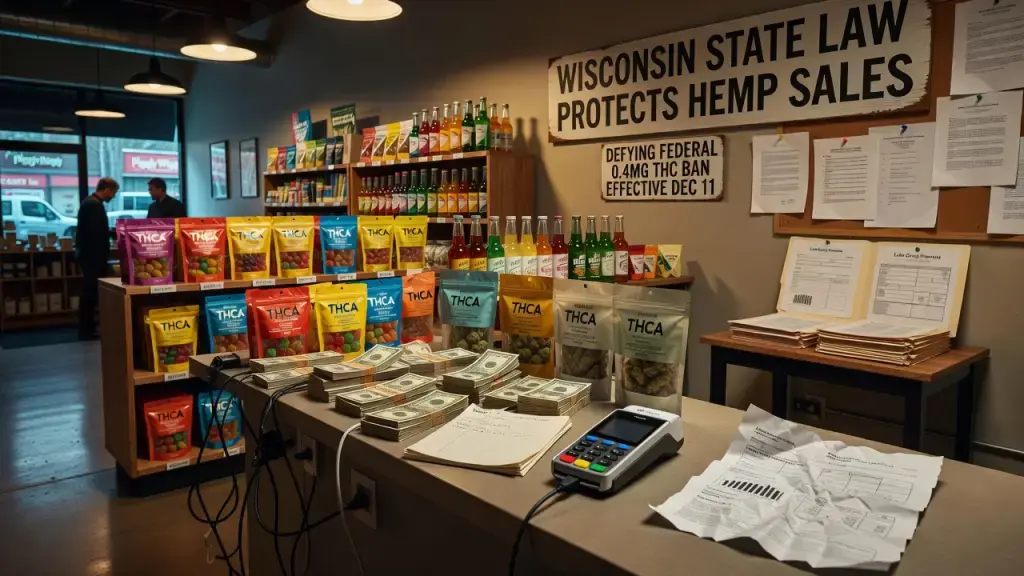
A federal rule set to take effect Dec. 11 will cut the allowable THC in hemp products to 0.4 milligrams per container, a threshold so low it effectively wipes out the bulk of Wisconsin's hemp retail shelf. Yet several Wisconsin retailers, including Milwaukee's Kind Oasis, say they intend to keep selling gummies and beverages that fall under the state's own THC limit, arguing state law still protects the business. It's a bet with real teeth to it - and not everyone in the industry is placing it the same way.
A legal gray zone, not a green light
The core tension here is straightforward enough on paper: Congress legalized hemp with under 0.3% delta-9 THC back in 2018, Wisconsin followed, and an entire retail category grew up around that framework. The new federal law effectively claws that back. But Wisconsin's statute hasn't changed. The state's own nonpartisan Legislative Council has said the federal ban "does not directly affect the legality of hemp under state law" - while also noting, in the same breath, that state law is no defense against a federal violation. That's the needle operators are trying to thread. Attorney Jason Tarasek frames it as Wisconsin simply joining the 41 states that already allow marijuana ahead of federal reform. Maybe. But marijuana states built regulatory scaffolding - licensing, testing, age gates - before opening for business. Wisconsin hemp did not.
Why Wisconsin's hemp market carries more exposure than most
Here's the catch that separates Wisconsin from adult-use markets that federal enforcement has largely left alone: there's no age limit on hemp purchases in the state, no mandatory lab testing for THC content or contaminants, and no packaging standard. Compare that to a licensed dispensary operating under seed-to-sale tracking, COA requirements, and child-resistant packaging rules, and the gap is obvious. A Milwaukee Journal Sentinel lab test of 30 products found most exceeded the federal THC limit, with some containing mold or a paint-stripper carcinogen. That's the kind of finding that gives regulators ammunition and insurers cold feet simultaneously. For operators, the lesson isn't subtle: an unregulated category is a fragile one, and fragility becomes a liability the moment enforcement attention shifts.
Banking, card processing and insurance tighten first
Even if no sheriff shows up at the door, the money side will bite first. Card processors won't knowingly run transactions for federally prohibited products, and Square has already told hemp merchants their accounts close Nov. 5. That pushes retailers toward cash-only operations or ACH-style pay-by-bank workarounds - the same workaround marijuana retailers have lived with for years under 280E and federal banking restrictions. Insurance is murkier still. Cory Lake of Lake Group Insurance, who covers roughly 300 hemp and cannabis clients, says he'll be making case-by-case calls once the ban takes effect, because without clear rules "it's tough to create an insurance policy." Grocery distributors are watching too; Piggly Wiggly and Woodman's have both paused larger hemp orders from supplier Canndigenous pending clarity.
What operators are actually doing about it
- Some retailers are dropping higher-risk SKUs first - Kind Oasis has already exited delta-8 and is reconsidering THCA flower, a category Congress specifically targeted.
- Others are holding steady, betting that a Democratic-controlled Congress reopens a legislative path for hemp, as Madison retailer Phillip Scott predicts.
- A portion of the market is expected to simply close; Scott estimates half of Wisconsin's hemp businesses will shut down, with roughly a quarter of survivors continuing to operate as they do now.
- Enforcement responsibility itself remains unsettled, with local police, including Milwaukee PD, saying they'll seek city attorney guidance before acting.
For wholesalers, landlords, and payment vendors serving this channel, the prudent move is the same one compliance teams in adult-use markets learned years ago: assume scrutiny is coming, document everything, and don't mistake silence from regulators for permission.