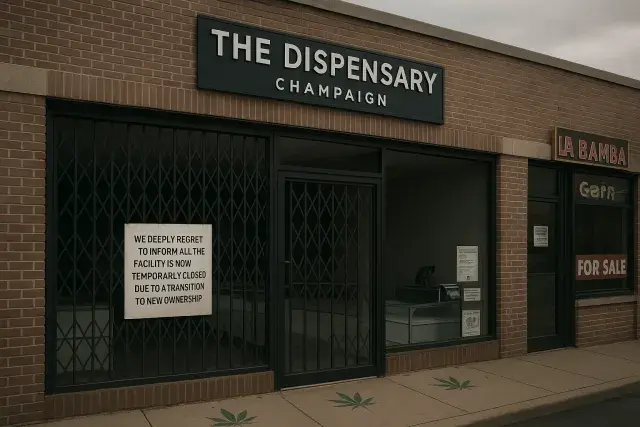
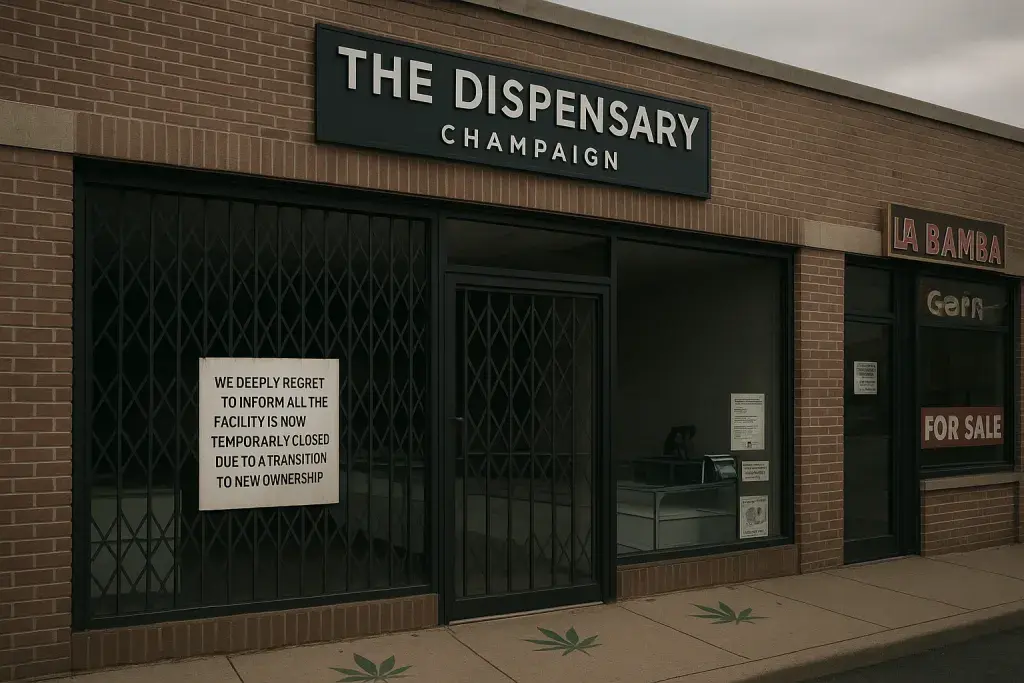
The Dispensary Champaign has shuttered, locking its doors after less than a year of adult-use retail operations at its location near La Bamba and Garcia's Pizza in Champaign, Illinois. The closure, confirmed by Principal Officer Jeff Soenksen, is tied to a sale of the licensed property - not a regulatory action or enforcement order. According to Soenksen, the owner is finalizing the transaction, with hopes that the site will reopen under new ownership and a different name.
What happened here is a scenario the broader cannabis retail industry knows well: a licensed dispensary location changing hands mid-operation, leaving staff, customers, and vendors abruptly in limbo. Ownership transitions in regulated cannabis markets are anything but simple. Unlike a standard commercial business sale, transferring a cannabis license requires regulatory review, state approval, and - depending on the jurisdiction - background checks, capitalization reviews, and revised operating agreements. These processes can take months, and the gap between the old operator walking away and the new one receiving approval is precisely when storefronts go dark. For comparison, operators using POS software for Alaska cannabis retailers or other highly regulated state markets understand that even technology infrastructure must be re-credentialed or transferred when ownership changes - a detail that catches some incoming owners off guard.
The Facebook statement posted by The Dispensary Champaign was direct: "We deeply regret to inform all the facility is now temporarily closed due to a transition to new ownership." The word "temporarily" is doing meaningful work in that sentence. It signals that the physical retail license tied to this address likely remains intact - or is in the process of being assigned - rather than surrendered or revoked. In Illinois, adult-use dispensary licenses carry significant value, given the state's regulatory framework and the limited number of licenses issued through its application process. A licensed dispensary location that sits dormant during a sale is still an active asset; it just isn't generating revenue, paying staff, or moving inventory.
The Human Cost of Quiet Closures
The Dispensary's own statement acknowledged what operators sometimes understate: the impact on staff. Budtenders, inventory managers, compliance leads, and front-of-house employees lost their positions with whatever notice - or lack of it - the transition allowed. In cannabis retail, this is a recurring friction point. Employees in the sector often cannot fall back on traditional banking or payroll continuity the way workers in other industries might, and sudden closures can leave open questions around final paychecks, benefits, and accrued time. That's not unique to this location, but it's worth naming plainly.
What an Ownership Transfer Actually Involves in Licensed Cannabis Retail
Illinois operates a tightly regulated adult-use cannabis market. A dispensary sale isn't simply a handshake and a deed transfer. The incoming owner must satisfy the Illinois Cannabis Regulation and Tax Act's requirements, which include state licensing authority review of the proposed new principal officers and controlling parties. Inventory on-hand at the time of closure must be accounted for through seed-to-sale tracking systems - in Illinois, that means METRC compliance logs must reflect accurate stock levels so product isn't simply unaccounted for during the transition. This is a live compliance obligation even when the lights are off.
The POS system, product batches, compliance documentation, and wholesale vendor relationships all hang in suspension during the ownership gap. Brands and distributors that supplied the Champaign location are now waiting to learn whether the incoming operator will continue existing wholesale relationships or rebuild the vendor network from scratch. Landlords, too, sit in an unusual position - a cannabis tenant with a valid state license is a specialized occupant, and the lease assignment process in cannabis retail often requires separate regulatory sign-off, not just a standard commercial sublease amendment.
Broader Context: Short-Run Dispensaries in a Maturing Market
The Dispensary Champaign opened in the summer of 2024 and operated for less than a year before closing. That timeline matters for context. Illinois's adult-use market, while established, is not insulated from the same pressures compressing cannabis retail margins across the country - high state excise tax burdens, federal 280E tax treatment that disallows standard business deductions, rising real estate costs, and intensifying competition as more licensed operators enter the market. A dispensary open less than twelve months hasn't had time to build the customer loyalty, operational efficiency, or wholesale pricing leverage that makes a location durable.
None of that means the Champaign location failed for any one identifiable reason - ownership decisions are their own category. But the timing reflects a broader pattern in maturing state cannabis markets: locations that opened during the initial expansion phase are being consolidated, repositioned, or sold as the economics of regulated retail get harder to absorb at the single-store level. Whether the incoming owner restores this site to active retail, and under what brand, remains to be seen. What is clear is that the Champaign community near that plaza lost a licensed retailer - at least for now.