A webinar on DEA enforcement and cannabis rescheduling drew more questions than a single hour could answer, and the gaps matter. Operators, patients, and hemp businesses are making real decisions right now based on incomplete information about what Schedule III actually changes. Here's a closer look at several of the thorniest unresolved issues, with the caveat that these are interpretations of a still-developing legal picture, not settled law.
Schedule III status does not equal federal compliance
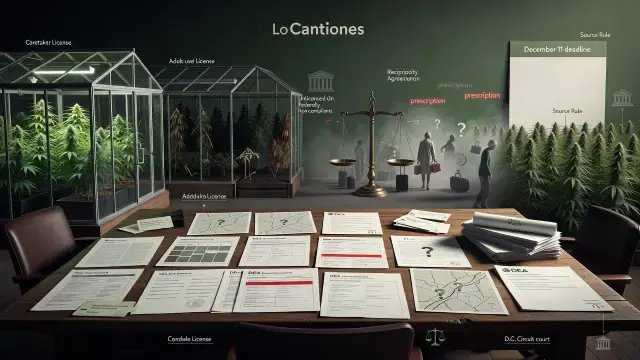
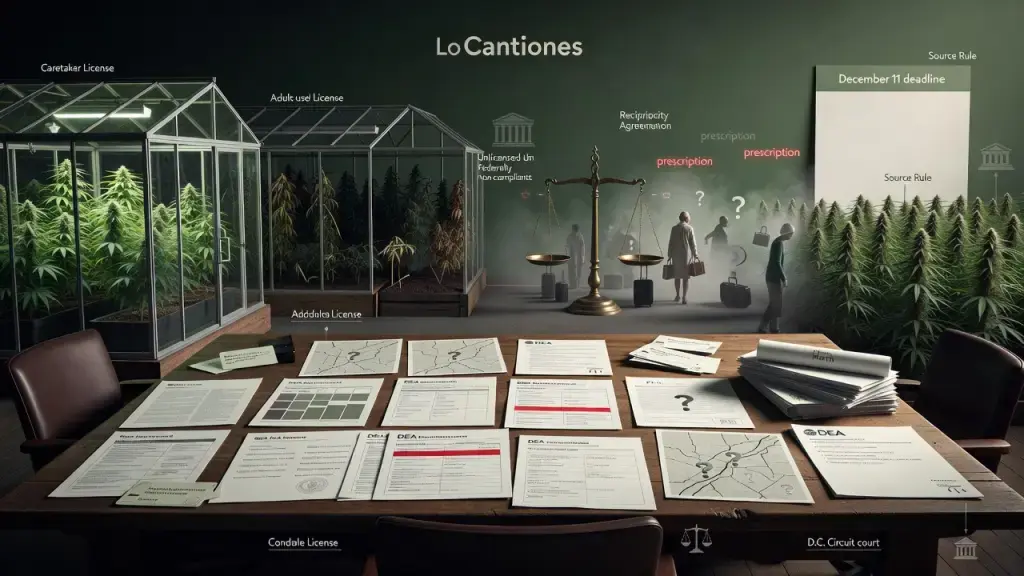
The Final Order moved marijuana subject to a state medical marijuana license into Schedule III. That's a narrower category than many assume. Home grows licensed under a state's medical program, such as a caretaker license, qualify. Adult-use grows and unlicensed medical cultivation generally do not. The distinction turns entirely on whether a qualifying state license is attached to the activity, not on whether the state program is "medical" in a general sense.
Here's the catch that trips up a lot of operators: Schedule III classification and federal legality are not the same thing. Under the Final Order, a licensee needed to apply for DEA registration during the expedited window that closed in June to be treated as lawfully operating while that application is pending. Miss that window, or never apply, and the operation remains in violation of federal law regardless of Schedule III status. For dispensary operators and multi-state operators tracking compliance exposure, that window closing is a much more consequential date than the rescheduling announcement itself.
Patient travel and reciprocity remain murky
Medical marijuana patients hoping the Final Order cleared a path for interstate travel should proceed cautiously. The order addresses entities dispensing to patients, not patients themselves. A provision sometimes cited, 21 CFR 1301.13(k)(5), governs dispensing by registered entities and does not establish patient rights or protections directly. State law still governs possession and transport, and some states remain hostile regardless of a patient's home-state credentials.
Reciprocity faces a similar fog. Reports have circulated that DEA will not permit medical marijuana reciprocity across state lines, but the Final Order contains no such prohibition in its text. Absent a binding rule, order, or memorandum of agreement addressing reciprocity directly, those reports should not be treated as enforceable restriction. Until federal agencies issue clearer guidance, patients and dispensary staff advising them are better off treating interstate travel the same way they did before the order.
"Prescription" language is a red herring
State-legal medical marijuana has not become a prescription drug under the Federal Food, Drug, and Cosmetic Act simply because it sits in Schedule III now. The heading "Prescriptions" in 21 CFR 1301.13(k)(5) is misleading on its face; the provision actually discusses certifications and other documents that state law recognizes as sufficient for dispensing. DEA did not require traditional prescriptions, which is exactly why the industry has long used terms like "recommendation" and "certification" instead. Had DEA gone the prescription route, products would need to meet FDCA approval requirements that state-legal cannabis products simply do not satisfy.
Hemp's December deadline looms larger than the midterms
Electoral politics will not move the rescheduling proceedings pending before the D.C. Circuit or a DEA administrative law judge; those are executive and judicial processes, not legislative ones. Hemp policy is a different story, but even a strong showing by either party in the midterms is unlikely to produce a legislative fix before the new Congress convenes in January. That leaves the December 11 deadline as the immediate pressure point for hemp cultivators, processors, and retailers.
The more realistic outcomes are another continuing-resolution extension, possibly pushing the deadline into March, or the restrictions taking effect as scheduled. Seeds appear likely to be classified as marijuana once the restrictions kick in, absent further action from Congress, which creates real exposure for breeders and nurseries operating in that space. Clones and tissue cultures sit in a comparatively better position since they weren't expressly swept into the restrictions, though the so-called Source Rule, which ties a cannabinoid's legal status to its source material, could still be invoked by a prosecutor looking for a theory.
For compliance teams and supply chain managers, the practical takeaway is the same across every one of these questions: treat rescheduling as a narrow, conditional shift rather than a broad green light, and keep built-in margin for state law, licensing deadlines, and enforcement discretion that federal rulemaking has not yet resolved.