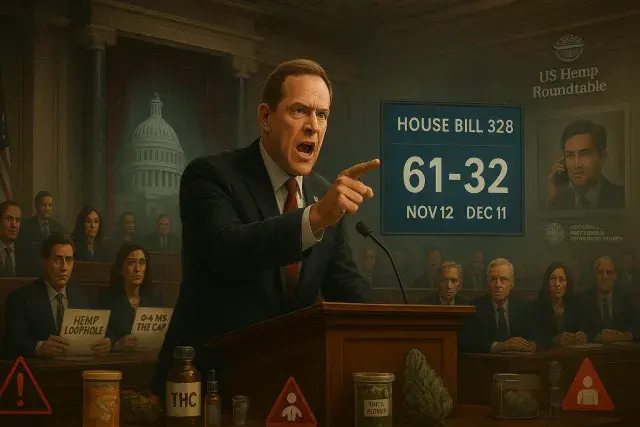
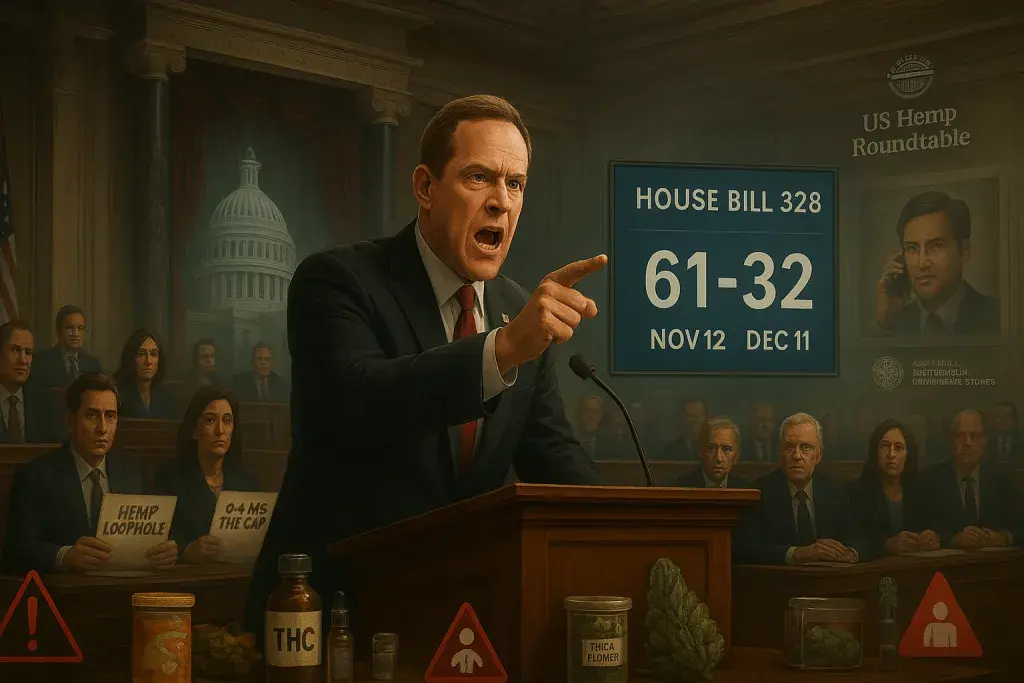
A one-vote-shy-of-two-thirds Senate coalition just bought the intoxicating hemp industry an extra month of runway, and the fight over how that month gets used is far from settled. Sen. Ted Budd, R-NC, tried and failed last week to strip a 30-day delay from the chamber's continuing resolution, a delay that pushes the effective date of sweeping new federal hemp restrictions from Nov. 12 to Dec. 11. Senators voted 61-32 to table his amendment, with a cross-party bloc of 21 Republicans and 11 Democrats siding with Budd against leadership's preferred timeline.
For operators selling THC beverages, delta-8 gummies, vapes, or THCA flower under the hemp exemption, the practical stakes are straightforward: the countdown clock toward a 0.4-milligram total THC cap per container is still running, just with a short reprieve. That threshold, enacted by Congress in November 2025, would functionally eliminate most of today's intoxicating hemp SKUs from convenience stores, smoke shops, and gas stations nationwide. Retailers watching this fight from the sidelines - including multi-state cannabis operators who compete against unregulated hemp products on price and shelf space - have reason to track the outcome closely, the same way a dispensary evaluating dispensary software in Ontario would track shifting compliance requirements before locking in a point-of-sale system built around the wrong assumptions.
Why the delay mattered enough to fight over
Budd's argument was blunt: Congress already voted to close what he called the hemp loophole, and any additional delay simply extends the window during which intoxicating products marketed in packaging resembling snack foods and candy remain on convenience store shelves. He cited North Carolina emergency department data showing cannabis-consumption-coded visits among minors rose sharply between 2017 and 2025, framing the issue as a consumer-safety and public-health matter rather than a purely regulatory dispute. That framing put him at odds with the White House, which reportedly worked the phones directly, and with CMS Administrator Dr. Mehmet Oz, who warned that letting the broader restrictions take effect on schedule could disrupt recent efforts to expand senior and disability access to full-spectrum hemp-derived CBD.
The opposing coalition - 105 organizations, including the US Hemp Roundtable, the National Association of Convenience Stores, and several North Carolina hemp trade groups - argued the 30-day cushion gives Congress room to legislate real guardrails: age verification, good manufacturing practices, and import restrictions targeting synthetic cannabinoids sourced from China. That's the tension running through this whole debate. A flat THC threshold is easy to enforce but blunt; a regulatory framework built around testing, labeling, and packaging standards is more precise but takes time nobody in this fight seems willing to concede.
North Carolina's parallel deadlock adds another layer
Back home, Budd's own state legislature is stuck on the identical question. House Bill 328 would write the same 0.4-milligram cap directly into North Carolina law, along with a 21-and-older sales restriction, meaning the state ban could survive even if Congress eventually softens the federal rule. The Senate adopted the conference report 37-6 in July, but the House has repeatedly declined to vote on it, leaving the bill parked in the Rules Committee. House Speaker Destin Hall has acknowledged the state's largely unregulated hemp market can't continue as-is, but consensus on the remedy remains elusive.
For compliance teams and wholesalers stocking hemp-derived cannabinoid products, the lesson here isn't which side wins - it's that the underlying rules are still genuinely unsettled at both the federal and state level, with a hard date now sitting on the calendar in December instead of November. Inventory planning, wholesale menus, and COA documentation built around one THC threshold may need rapid revision if either Congress or Raleigh moves before year's end. Betting the business on the status quo holding indefinitely looks increasingly like the riskier position.