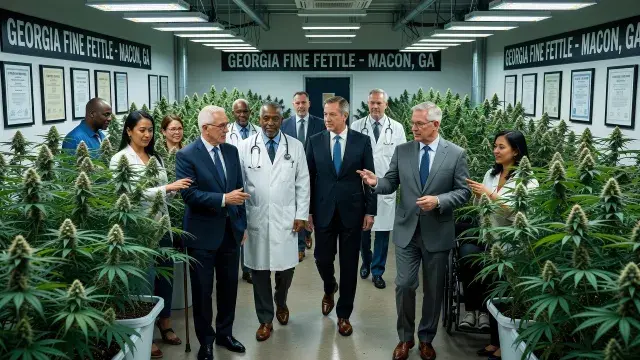

A licensed medical cannabis operator in Macon is trying a different kind of lobbying strategy: instead of sending lawyers to the Capitol, it brought lawmakers, physicians, and patients into its own grow rooms. Georgia Fine Fettle, one of only three companies licensed to cultivate, manufacture, and distribute medical cannabis products in the state, hosted a facility tour aimed at breaking a legislative logjam that has stalled expansion bills for years. The tour matters less as a public-relations gesture and more as a case study in how tightly regulated cannabis markets try to move policy when the traditional channels stall out.
Georgia's medical cannabis program has been legal for a decade, yet the operational footprint remains narrow. Three licensed producers serving an entire state is a tight supply chain by any measure, and it puts real pressure on inventory planning, wholesale distribution, and product availability at the dispensary level. Compare that to adult-use markets with dozens of cultivators and hundreds of retail licenses, and the gap in scale becomes obvious. Multi-state operators watching Georgia from the outside are also watching how neighboring and comparison markets handle distribution infrastructure - in New Mexico, for instance, licensed operators rely on cannabis distribution software new mexico platforms to manage seed-to-sale tracking, manifest generation, and compliance logging across a more decentralized retail network. Georgia's limited-license model means less of that complexity, but it also means less redundancy if a single operator faces a production disruption. cannabis distribution software new mexico
Why the Legislation Keeps Stalling
Senate Bill 220 and House Bill 227 both aimed to widen access - easing the process for patients to obtain a medical cannabis card and updating allowable product forms so patients could get more effective formulations. Neither bill made it through both chambers. That's not unusual for cannabis legislation generally; even in states with adult-use programs, incremental medical expansion bills often get shelved behind bigger-ticket tax or licensing fights. In Georgia specifically, the friction seems to be less about opposition to medical cannabis itself and more about the pace lawmakers are willing to move, given how politically sensitive the topic remains a decade after legalization.
The Access Gap Clinicians Are Flagging
Dr. Elmore Alexander's estimate that current products serve roughly 80% of patients well, leaving a smaller but meaningful population underserved, points to a familiar operational tension in limited-license medical markets: product form matters as much as legal access. If the approved product list doesn't include the formulations certain patients need, expanding the patient registry doesn't solve the underlying problem. For operators, that's a wholesale menu and SKU management issue as much as a policy one - production capacity and legislative product-form rules move on separate tracks, and one can't outrun the other.
What Expansion Would Mean for Operators and Regulators
If lawmakers eventually loosen card-access rules or broaden allowable product forms, the compliance burden shifts accordingly. More patients typically means more dispensary throughput, tighter demands on lab testing and COA verification, and added scrutiny on packaging and labeling consistency across batches. Regulators would need to weigh that growth against the state's current three-operator structure, since scaling patient access without scaling licensed production capacity tends to create shortages rather than solve them. For now, Georgia's medical cannabis market remains small, tightly controlled, and - as this tour suggests - still trying to convince its own legislature that the system is worth building out further.