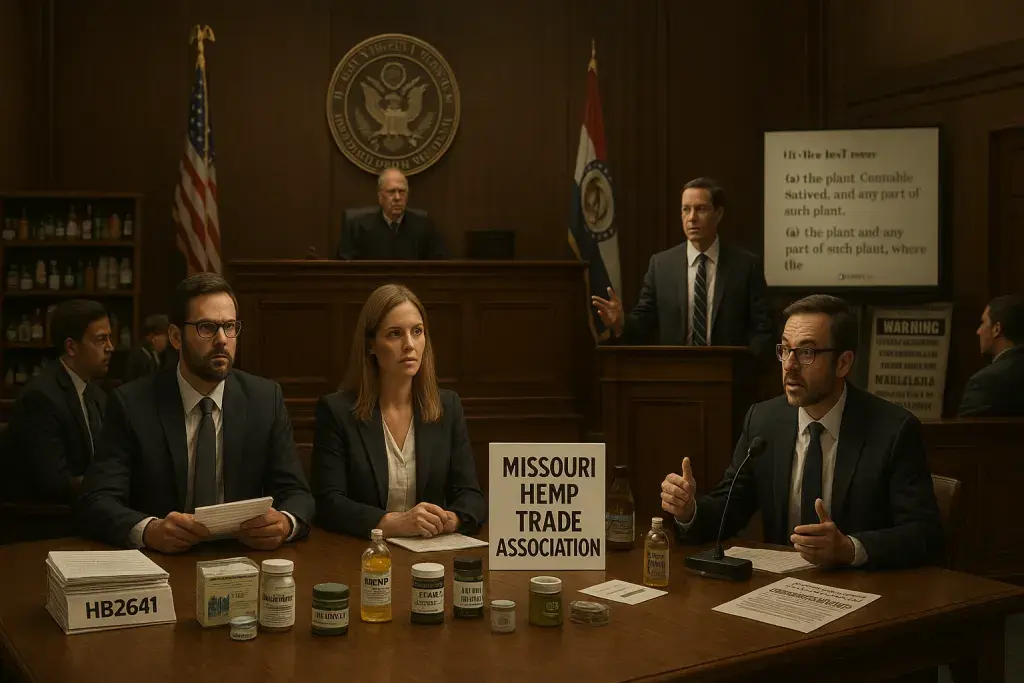
A coalition of hemp businesses filed a federal lawsuit Thursday seeking to stop Missouri's sweeping ban on intoxicating hemp products from taking effect November 12. The suit, filed in the U.S. District Court for the Western District, targets a law - House Bill 2641 - signed earlier this year by Gov. Mike Kehoe that would pull THC seltzers, hemp-derived cannabinoid products, and similar items from bar shelves, grocery stores, and smoke shops statewide. The plaintiffs argue the legislation is so poorly drafted it creates criminal liability where none should exist.
The coalition includes MNG 2005, Inc. - parent company to 55 CBD Kratom retail locations nationwide - the Missouri Hemp Trade Association, and Wisconsin-based Lifted Liquids Inc. Their core argument isn't simply that the ban is bad policy; it's that the law's definitions of "hemp" and "marijuana" contradict each other depending on which provision you're reading, leaving retailers, law enforcement, and prosecutors with no coherent standard to apply. For licensed cannabis operators watching from the sidelines, this kind of statutory ambiguity is a familiar headache - the sort of drafting problem that turns compliance into guesswork. Businesses in adjacent regulated markets, including those operating a dispensary pos system Michigan environment, understand acutely how vague statutory language cascades into inventory classification errors, reporting failures, and - worst case - criminal exposure for staff and owners alike.
What's striking here is the specific mechanism of the complaint. The lawsuit doesn't merely allege harm to business revenue. It asserts that the same product can be classified as legal hemp in one section of HB2641 and as unlicensed marijuana in another - and since unlicensed marijuana activity is a criminal offense in Missouri, that definitional conflict carries real stakes. Craig Katz, government relations and compliance manager for MNG 2005, put it plainly: legislators who don't understand how hemp chemistry, product formulation, and federal scheduling interact produced a bill that "doesn't make a whole heck of a lot of sense." That's not a rhetorical complaint. It's a compliance nightmare with potential criminal consequences attached.
What the Law Actually Does - and Why the Industry Objects
HB2641 largely mirrors the federal hemp ban Congress approved last year, which targets intoxicating hemp-derived products - including delta-8 THC, delta-10, and high-dose hemp gummies and beverages that have proliferated in unregulated retail settings since the 2018 Farm Bill created the statutory opening for them. Under the Missouri bill, if Congress reverses course and permits these products nationally, the state would only allow their sale inside licensed marijuana dispensaries. If Congress delays the federal ban, Missouri would still prohibit everything except intoxicating beverages. Either way, the bill dramatically narrows the legal market - and funnels whatever remains into the licensed dispensary channel.
That last point is what Missouri Hemp Trade Association president Jay Patel called "a government-mandated monopoly." It's a pointed accusation, and it reflects a tension that regulated cannabis markets across the country haven't fully resolved: hemp-derived intoxicants currently exist in a gray zone, sold in smoke shops and gas stations without the licensing, lab-testing requirements, seed-to-sale tracking, or compliant packaging that licensed dispensary operators must maintain. The hemp industry's argument is that it built a legal business under federal law. The licensed cannabis industry's counter - rarely stated publicly - is that unregulated hemp products undercut the compliance costs dispensaries absorb to operate lawfully.
The Interstate Commerce Problem
The lawsuit raises a second front worth watching: interstate commerce. While HB2641 ostensibly does not interfere with interstate hemp transport, the coalition argues the law simultaneously restricts who may move hemp products through Missouri - a potential Commerce Clause problem under federal constitutional analysis. Hemp businesses that operate distribution networks crossing state lines have operational exposure here that goes well beyond Missouri's borders. If the state can effectively block through-shipments, that disrupts supply chains for businesses that never intended to sell a single product in Missouri at all.
The bill's sponsor, Rep. Dave Hinman (R-O'Fallon), isn't persuaded the lawsuit changes the calculus. He characterized the legal challenge as a last-ditch effort by an industry that lost the legislative fight and dismissed the prospect of the courts reversing a measure that cleared both chambers and received the governor's signature. His read may prove accurate - courts don't lightly enjoin duly enacted state laws on pre-enforcement challenges. But "vagueness" claims have teeth when criminal liability is attached to undefined terms, and the plaintiffs' argument that the law inadvertently sweeps non-intoxicating CBD products off shelves alongside THC beverages gives a court something concrete to examine.
Implications for Licensed Operators and Retailers
For Missouri's licensed dispensary operators, this lawsuit is worth watching for reasons that have nothing to do with hemp. If the court grants a preliminary injunction and delays the November 12 effective date, intoxicating hemp products remain on smoke shop and grocery store shelves - competing with dispensary inventory - through at least the duration of litigation. That's a direct revenue consideration for operators already managing tight wholesale margins and excise tax obligations that their unregulated competitors don't carry.
If the lawsuit fails and the ban takes effect as written, the compliance uncertainty the coalition describes doesn't disappear - it shifts to retailers, distributors, and anyone holding hemp inventory at the wrong moment. Businesses that need to liquidate or reclassify product before the deadline will face the same definitional confusion the lawsuit identifies. What counts as covered? What ships out by when? Operators who've built compliance programs around ambiguous statutory definitions know that enforcement discretion doesn't make an unclear law workable - it just makes exposure unpredictable.
The broader pattern here is familiar to anyone who covers regulated cannabis: states moving to close the hemp gray market are doing so with legislation drafted faster than the underlying science and commerce can be accurately described. The result is law that creates new compliance burdens without providing the clarity those burdens require to be operational. Missouri may well join the federal framework in November. Whether it does so with a statute that can actually be enforced is a different question - and one a federal court may now have to answer.