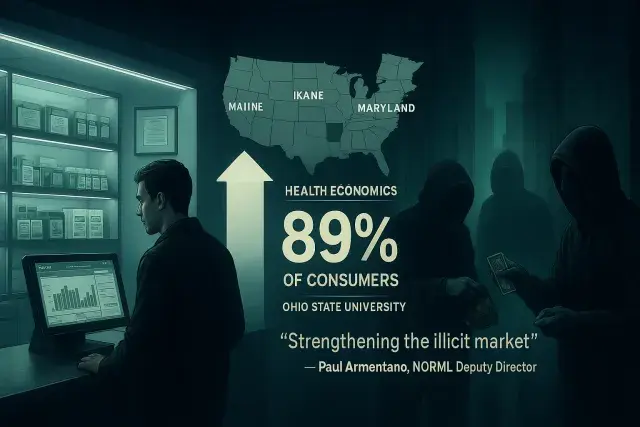
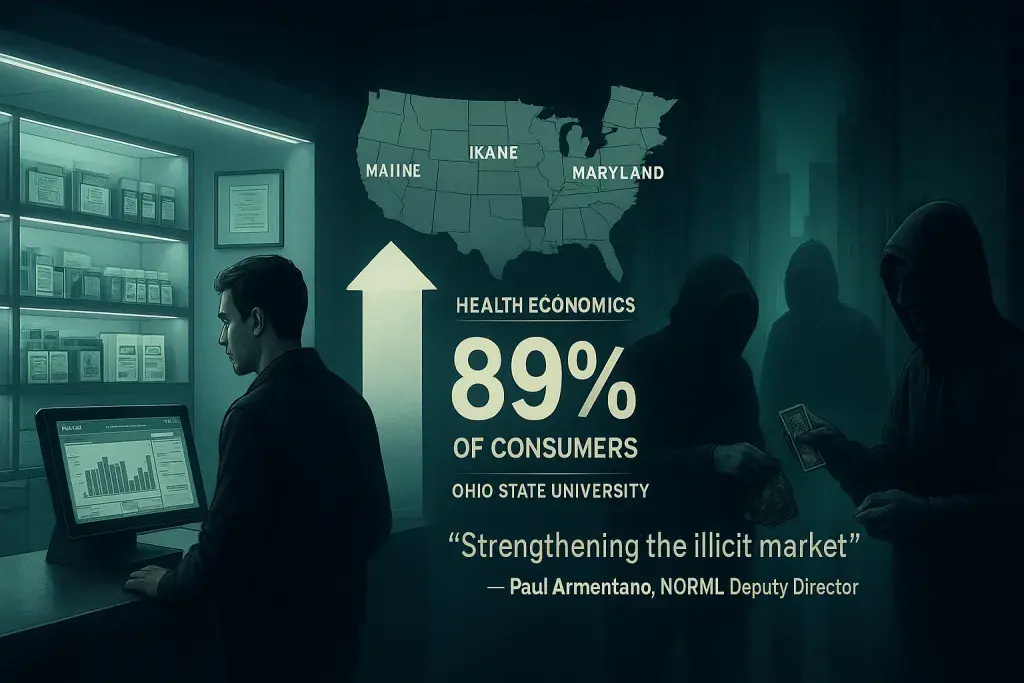
New peer-reviewed research delivers an unwelcome data point for state treasuries betting on cannabis excise revenue: raise the tax on legal weed, and a large share of that lost business doesn't disappear - it migrates to the unregulated market. A study published in Health Economics, conducted by researchers affiliated with Ohio State University, found that price increases driven by taxation significantly reduce legal cannabis purchases, but roughly 89 percent of that reduction gets offset by consumers switching to illicit-market products instead.
That finding matters for anyone running a licensed dispensary, not just policymakers drafting tax schedules. Every point of markup passed through to the consumer at the register competes directly against an illicit seller who pays no excise tax, carries no compliance overhead, and skips lab testing entirely. Operators tracking margins through a point-of-sale system already feel this pressure in SKU-level sales data; a spike in shelf price for a given batch often shows up as a corresponding dip in unit volume within weeks. For multi-state operators managing California storefronts, a California dispensary POS platform can surface exactly which price tiers trigger that drop-off, giving retailers real evidence to bring into state tax policy conversations rather than relying on gut instinct. California dispensary POS platform
Why Legal Retail Can't Simply Absorb the Tax
Dispensaries already operate under 280E, the federal tax code provision that bars cannabis businesses from deducting standard operating expenses because the plant remains federally illegal. Layer state and local excise taxes on top of that, and gross margins get squeezed from two directions at once. Retailers can't easily eat a tax hike without cutting into already-thin net income, which means the increase usually gets passed to the consumer at the point of sale. The study's authors put it plainly: increasing prices through taxes on legal products drives consumption toward illegal products. That's not a policy abstraction - it shows up in wholesale menu adjustments, in shrinking foot traffic, and eventually in inventory that sits too long on budroom shelves.
State Lawmakers Are Already Split on the Approach
The states named in the underlying NORML brief illustrate two very different bets. Maine, Maryland, Michigan, and Minnesota each raised cannabis-related taxes last year, presumably chasing near-term revenue gains. California moved the opposite direction, with California NORML successfully pushing to roll back marijuana-related tax rates. In Washington, D.C., the City Council rejected a budget proposal that would have significantly raised retail cannabis sales taxes. NORML's Deputy Director Paul Armentano has argued that excessive taxation "strengthens illicit markets while weakening legal ones," pointing out that unlicensed sellers don't check identification, don't test products for purity, and don't return revenue to local communities.
What This Means for Compliance and Consumer Safety
The policy debate isn't only about revenue. Every dollar of legal cannabis sales that shifts to an unlicensed seller also represents a product that skipped lab testing, a certificate of analysis that never existed, and a transaction with no age verification at all. Regulators weighing tax hikes are, in effect, weighing consumer protection against short-term budget targets - a tradeoff that deserves more scrutiny than it typically gets in legislative sessions.
- Higher excise taxes correlate with reduced legal-market consumption but not reduced total consumption
- Illicit-market products bypass COA testing, compliant packaging, and age-restricted sales controls
- 280E already limits legal operators' ability to absorb added tax burden without raising retail prices
- States taking divergent approaches - tax hikes versus rollbacks - offer a natural policy comparison in coming years