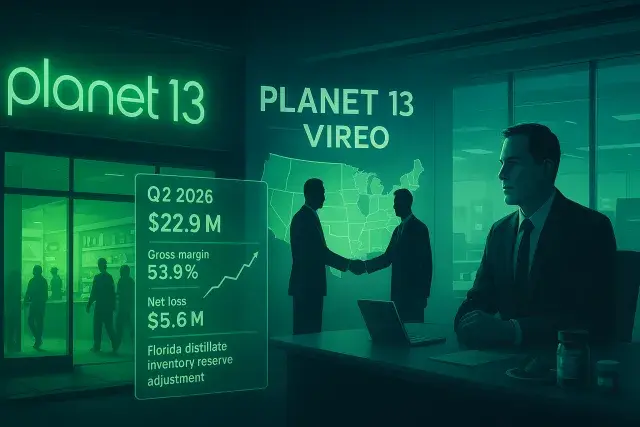
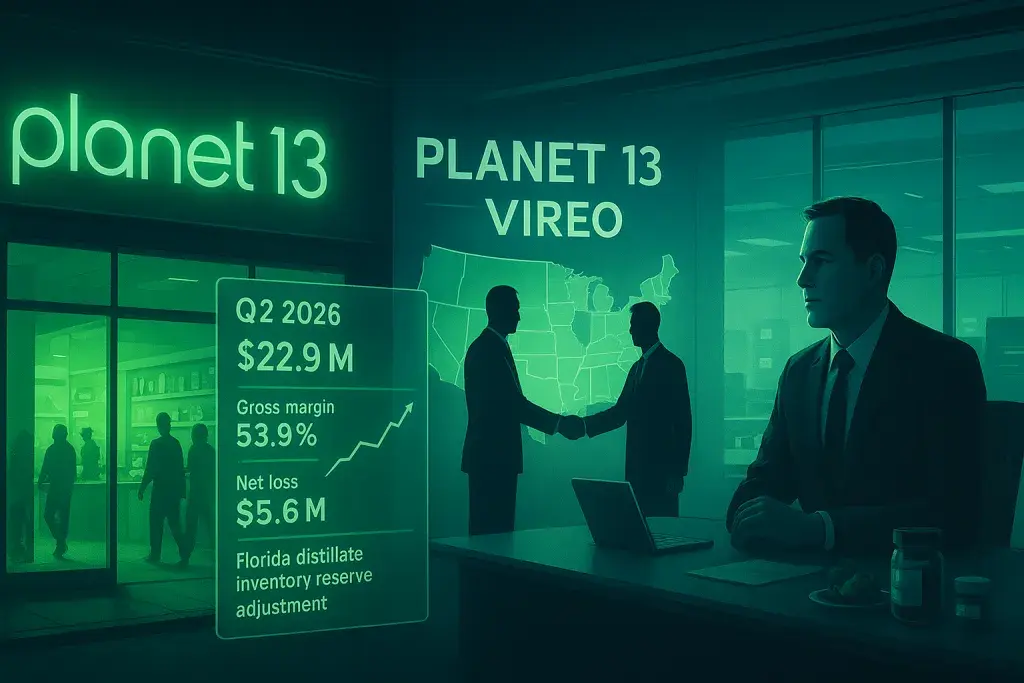
Planet 13 Holdings posted second-quarter 2026 revenue of $22.9 million, down 14.9% from the prior year, but the numbers underneath tell a more useful story than the headline decline suggests. Gross margin climbed to 53.9% from 43.4% a year earlier, and the net loss narrowed to $5.6 million from $13.3 million. The results land as the Las Vegas-based multi-state operator works toward closing its previously announced merger with Vireo Growth Inc., a deal that will reshape how the combined company competes in an increasingly margin-starved cannabis retail market.
Retreat From California Reshapes the Ledger
The exit from California retail and wholesale operations did what these exits usually do to a top line: it shrank revenue while cleaning up the cost structure. Planet 13's total expenses fell 17.7% to $15.2 million, and the company points to that California withdrawal, alongside company-wide procurement initiatives, as the primary driver of margin improvement. That's a familiar trade-off in multi-state operator finance right now. California's cannabis market carries some of the steepest price compression in the country, driven by an oversupplied cultivation base and a legacy market that continues to undercut licensed retail on price. For operators without the scale to absorb that compression, walking away from unprofitable footprint can improve the numbers that matter to lenders and shareholders, even as it shrinks the numbers that matter for growth narratives.
Florida's Distillate Reserve Adjustment Deserves a Closer Look
One line item worth flagging for anyone tracking inventory accounting in cannabis: Planet 13 reduced its inventory reserve for Florida distillate by $1.0 million as increased Florida sales worked down excess stock. Strip that adjustment out and gross margin was 49.5% rather than 53.9%. That's not a red flag, exactly, but it is a reminder that reported margins in this sector often carry one-time or non-recurring adjustments that inflate or deflate the picture depending on inventory reserve movements. Anyone comparing quarter-over-quarter margin trends across multi-state operators should always ask what's baked into the number versus what's structural. Florida revenue itself grew 17.1% sequentially, which the company frames as evidence of stabilization in a state where regulatory and competitive dynamics have pressured smaller operators for the better part of two years.
Nevada and Florida Price Compression Isn't Going Away
Both of Planet 13's core operating states, Nevada and Florida, continue to see price compression, a pattern showing up across most mature adult-use and medical markets as licensed cultivation capacity outpaces demand growth. For dispensary operators and wholesale buyers, this dynamic changes how budroom inventory gets priced, how aggressively brands need to discount to move product batches, and how thin margins get on the retail floor even when foot traffic holds steady. It also puts pressure on point-of-sale and inventory systems to track SKU-level profitability more precisely, since flat or declining average ticket prices mean operators can no longer rely on volume alone to cover fixed costs like rent, payroll, and compliance overhead.
The Merger Logic and What Comes Next
Co-CEO Bob Groesbeck's comments frame the Vireo Growth merger candidly: the market rewards scale, purchasing power, and distribution reach, and a smaller balance sheet has a harder time absorbing continued price compression. That's a fair reading of where multi-state cannabis retail sits today. Consolidation among licensed operators has been building for several years as companies weigh the cost of compliance infrastructure, seed-to-sale tracking obligations, and 280E tax exposure against shrinking per-unit margins. Because the merger is pending, Planet 13 opted not to hold a quarterly conference call, a detail that signals the company is now managing toward a transition rather than an independent long-term strategy. For dispensary staff, patients, and customers in Nevada, Illinois, and Florida, the practical effect for now is continuity of operations, with the more consequential changes likely arriving once the deal formally closes.