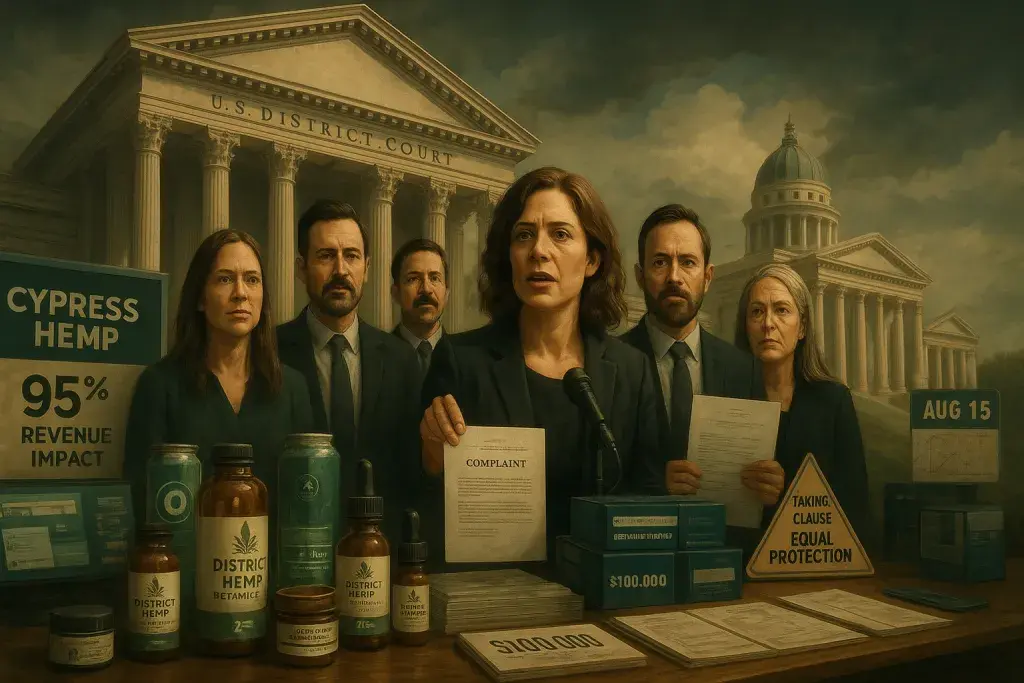
Seven Virginia hemp businesses filed suit July 31 in the U.S. District Court for the Western District of Virginia, asking a judge to block a budget provision that eliminates a long-standing exception allowing consumable hemp products to exceed 2 milligrams of total THC per package when paired with at least 25 times as much CBD. Without that carve-out, the plaintiffs say much of their current inventory becomes unsellable the moment the rule takes effect August 15. That's a hard deadline for companies that built supply chains, retail leases and staffing plans around a regulatory framework the state adopted just two years ago.
The mechanics here matter for anyone running a hemp or cannabis-adjacent retail operation. Virginia's 2023 law set a 2-mg THC cap per package but carved out an exception for CBD-dominant products with a 25-to-1 ratio - the provision now being struck. Compliance teams across the industry track these thresholds the same way a licensed dispensary tracks batch potency through seed-to-sale software; change the formula overnight and every SKU on the shelf, every COA on file, and every point-of-sale configuration built around those numbers needs to be redone. Operators in other states have faced similar retrofits when regulators tightened potency limits, and the back-end lift is rarely trivial - inventory systems, age-gating rules and even platforms like a South Dakota dispensary POS platform have had to be reconfigured on short notice when state cannabis rules shifted underneath existing business models. South Dakota dispensary POS platform
Forty Days Isn't a Transition Period, It's a Cliff
Plaintiffs received formal notice on July 6 - leaving roughly 40 days to reformulate products, redesign packaging, renegotiate manufacturing contracts and dispose of noncompliant stock. In regulated retail, that timeline would be tight even for a single SKU change. For companies carrying beverages, tinctures and edibles formulated under the 25-to-1 exception, it means simultaneous reformulation across entire product lines with no compensation mechanism and, according to the complaint, no path to sell down existing inventory before the cutoff. District Hemp Botanicals says it holds about $10,000 in now-affected inventory against more than $181,000 in outstanding obligations to creditors - the kind of mismatch that turns a policy change into a solvency problem. Cypress Hemp says the affected category represents roughly 95 percent of its revenue.
Consumer Safety Framing Versus Business Reality
Virginia officials argue the change closes a loophole that let intoxicating products move through vape shops and convenience stores without the testing, packaging and age-verification requirements applied to licensed marijuana retail. That's a legitimate regulatory concern - unregulated retail channels selling THC-infused products without consistent lab testing or child-resistant packaging is a real consumer-safety gap in many states, not just Virginia. But the plaintiffs counter that the existing framework already requires independent lab testing, warning labels, child-resistant packaging and a minimum purchase age of 21, and that the new standard measures total package THC without accounting for concentration, serving size or actual intoxicating effect. Whether a judge finds that distinction constitutionally meaningful is a separate question from whether it's good policy - but it's the crux of the takings and equal-protection claims in the complaint.
What Comes Next for the Broader Market
Virginia's adult-use marijuana retail market isn't scheduled to open until July 1, 2027, which means hemp retailers currently selling THC-infused beverages and edibles have no regulated replacement channel for nearly two years. Critics, including Marijuana Justice's Chelsea Higgs Wise, argue the state needs a defined inventory wind-down period and public education effort rather than an abrupt cutoff - echoing complaints from 2021, when Virginia legalized possession without building out retail guidance. Meanwhile, the federal picture is tightening too: a provision signed into law last year limits finished hemp-derived cannabinoid products to 0.4 mg of total THC per container starting November 12, a threshold well below even Virginia's revised cap. For dispensary operators, wholesalers and compliance officers watching from other states, the case is a reminder that hemp's regulatory footing remains unsettled at both the state and federal level, and that inventory planning built on today's thresholds carries real exposure if those thresholds move again.